John Riley was born (as best as I can make out) on-board the convict ship, the Kitty as it found its way to the fledgling Australian colony in 1792. Some accounts have him being born on arrival and some have him being born aboard the ship. What is for sure is that he was the free-born son of his mother Susannah Nairn/Nairne a convict who was bound for Australia. Despite the fact that he was given the name Riley (which was his mother’s husbands name back in England). The time she had spent incarcerated and the time spent on the voyage out to the colonies meant he could not have been John’s biological father. Hence John becomes a brickwall in our journey backwards for his paternal line. John’s mother would later re-marry this time to a fellow convict, Robert Wells in Parramatta, in New South Wales. John had at least one half sibling from his Wells step-father and mother. His sister was Esther Wells. John also had (I expect) another half-brother left behind in England in Thomas Riley.
Catherine Lattimore was a native of England. After much hunting I’ve been able to find a record which I hope answers the ‘how old was she’ question. According to the 1828 Australian census, Catherine gave her age as thirty and that she was born in either 1797 or 1798. All the other records on the census match from what is known about her. Catherine is also recorded with the spelling of Lattimore along with Latimore, Latimer and Lattimoore and at one stage even Lettermore so it gets a bit confusing.
Her parents could be John and Elizabeth Lattimore, baptized 21 Feburary, 1797, Birmingham, St Phillips parish, Warwickshire.

Catherine was convicted at the Warwick Lent Assizes I’m estimating at the age of 15 or 16. This occurred on the 29th March 1813 for the charge of larceny. She was accused of stealing from a shop. Catherine was sentenced to death which was commuted to transportation aboard the Wanstead to the colony of Australia for 7 years. (However on other muster records it says ‘life’). This was not the first time Catherine had fronted the Warwick Assizes. She had previously been tried at the Warwickshire Lent Assizes in 1808 for larceny. On that occasion she had been acquitted, perhaps her young years was the reason she was acquitted at that time or not enough evidence? At that time she was recorded as Cathe Latimoore.
Following her arrival in Australia aboard the Wanstead, (9 January, 1814) at Port Jackson, Sydney Cove, Catherine was assigned to the Parramatta Convict Women’s Factory as a Mantua Maker (cloaks for ladies). A mere year later she gained permission to marry John Riley (also found as Ryley) at Parramatta. They married on the 13th June 1814 at St John’s church in Parramatta, by banns. Their marriage was officiated by the colloquially known “flogging parson” Reverend Samuel Marsden. So named for his reputed predilection towards apportioning flogging as a punishment for criminal activity. At the time Catherine would have been around sixteen years old.
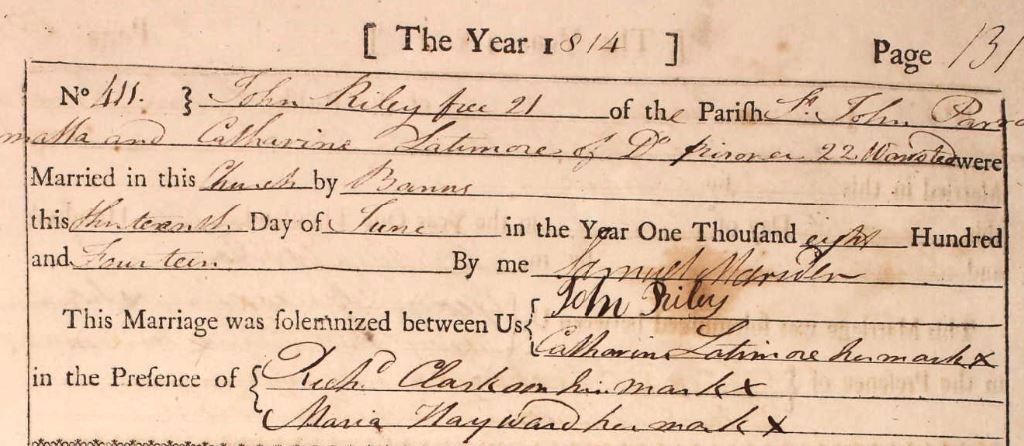
On the 1825 convict muster Catherine is recorded as the wife of John Riley. By March 1822 the Riley’s had moved up the social scale in the colony when John was appointed to the position of District Constable in Prospect, NSW. Whilst there were some advantage to this ‘government’ role, constable’s were not as a rule well liked by convicts, ex-convicts or settlers in the colony. On the 11th August 1826, John was accused in the ‘Up Country Police’ reportings in The Monitor, of robbing and allegations of extortion of settlers in the district and abusing his role as a district constable. John and Catherine both appeared in court alongside a John More. The two John’s had been accused of theft against one James Carr. John Riley was recorded as an accessory. However, it appears this was no simple accusation. James Carr, Maria Carr and a Jane Beams were accused by Catherine of assault and rescue. (Not sure what this meant). There was so much information given in the case both pro and con for each side that the case was referred to the Attorney General.
John and Catherine were recorded in the 1828 census as still living in Prospect. By this time, John and Catherine had three children. John aged 6, Diana aged 4 (my 3rd ggm who would go onto marry William London) and Susannah aged 2. They gave their religion as Protestant. During this time John was working as a Police Constable and pound-keeper in Parramatta. However the case with the Carr’s turned out? John must have been quit of wrong-doing as he was still a constable in 1837 and appears in print at different quarter-sessions (court hearings) in a witness/prosecuting role for different cases.
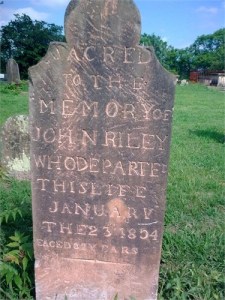
One of John’s roles whilst he was employed as a constable included bringing up prisoners (convicts still serving their terms) from Parramatta to Windsor in carts and conveying them to their places of allocation and work. John eventually left the police force and relocated his family to the Upper Colo where he bought 60 acres of land on the Comleroy Road near Slopes Road in the Kurrajong. The Kurrajong being not far from the township of Richmond in the Hawkesbury district of New South Wales. The property had been apparently known as “The Garden of Commons” for which I have not so far been able to find any references. During their married lives they added to their family Elisabeth Riley, Edward Riley and Martha Riley. John died on the 23rd January 1854. According to his grave headstone he was aged 61 and is buried at St. Peter’s Cemetery in Richmond.
After his father’s death in 1854, John and Catherine’s son, John (Jnr) Riley who was listed as his next of kin applied for letters of administration to the estate. John Riley Jnr, sold thirty acres of the existing farm to his brother-in-law Albert London for fifteen pounds. This land was on the lower half of the property and suited Albert in his farming endeavours. Immediately following his fathers demise John Riley Jnr had published a warning in the papers warning against purchasing any sheep, horses, property or personal items etc. from his parent’s property. I suspect he was ‘insuring’ against anything going missing from the farm prior to him completing his sales and closure of his father’s affairs.
What is very interesting however is that Catherine herself also put an advertisement in the papers and it stated: 25 May 1854, Sydney Morning Herald,
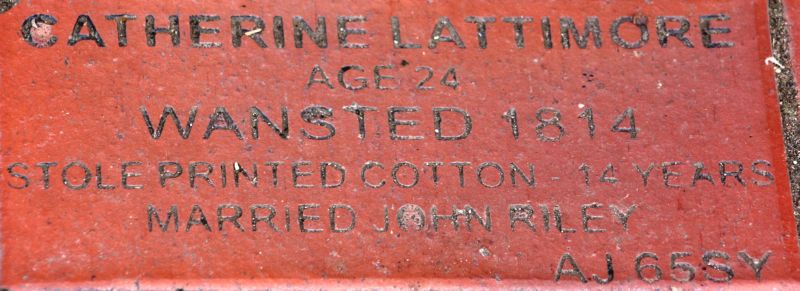
Catherine died in North Richmond on the 18th June 1868 and is also buried in the same graveyard as her husband but as I understand it not the same grave.
There is a most remarkable publication (available free online) at Women Transported, Life in Australia’s Female Convict Factories put together by the Parramatta Heritage Centre and University of Western Sydney, Catherine (Lattimore) is listed as one of the women in these factories. A fabulous read.
In a bizarre twist, Catherine’s mother-in-law, Susannah Nairn would marry a man called Robert Wells. After Susannah’s death he quickly re-married another convict, Sarah Longhurst who had arrived on the same ship (the Wanstead) with Catherine.
 Yews to Eucalypts
