Early Life:
London, England.
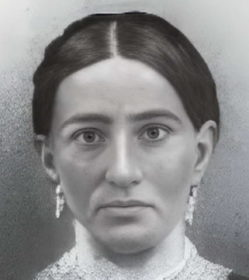
Walter Hancock I can now say with some assuredness was born in 1833. He was baptised at St Luke’s West Norwood, London, England. His death certificate (which I purchased) gave his age at death as 45, which was incorrect. He was 38 at his death. Walter was in custodial care at the time of his death. Louisa was born and raised a stones-throw away in Clapham in London, England. His certificate of death is notably sparse of detail. Walter was recorded as Hancox on his birth records which may have reflected how his parents pronounced their name.
Walter had eight known siblings. William Hancock b 1830, John Hancock b 1835, Martha Hancock b 1838, James Hancock b 1840, Anne Hancock b 1842, Henry Hancock b 1845, Jane Hancock b 1850 and Caroline Hancock b 1854.
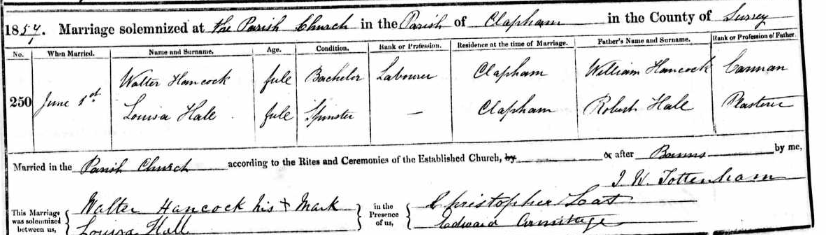
Walter married his wife Louisa Hall, (recorded as Hale on their marriage record) on the 1st June 1857 at her families parish church Holy Trinity in the parish of Clapham in England. Clapham being in the county of Surrey and an area of South London. Both would have been aged around 24 . It was remarked on their banns “full” meaning both had reached their full age of maturity (21 or over ) was a common reference at the time.
Louisa’s father was Robert Hall and Walter’s father was William Hancock. Robert was a plasterer and William a carman. As a carman William would have been delivering goods in a horse-drawn cart.
Louisa’s father Robert Hall (b 1803) was recorded as a plasterer. Louisa’s mother was Sarah Calton (b 1808.)
Whilst Walter may not have been able to read or write it would appear that Louisa could as she signed the register with her name. It would be reasonable therefore to conclude that the Hall family may have been in more comfortable financial or resourced circumstances than the Hancock’s. This access to resources of education can be evidenced in the occupation of the school-aged children in the 1851 census for the Hall family.
(Hall’s of Clapham)
The 1851 census of Clapham (Suburb of London, England) gave the Hall family living at White Square (Street name) Robert Hall aged 50 a plasterer and head of the house born 1801, MARRIED to Sarah Hall, wife, aged 43 married, born 1808.
Their children (who were at home at the time.) William Hall, son, bricklayer, aged 23 born 1828. Harriet (Hannah) Hall, daughter a scholar aged 11 born 1840. Jane Hall, daughter, scholar, aged 9 born 1842. Tom Hall, son, scholar, aged 7 born 1844. Emma Hall, daughter, scholar, aged 5 born 1846.Ellis/Alice, daughter, infant, aged 1 born 1850.
Children of Robert and Sarah Hall who were not recorded as living at the home at this census were Robert aged 21, Eliza aged 20, Louisa aged 18, Henry aged 16, Caroline aged 13 and Harriet aged 15.
A subsequent census in 1861 at the same address gave Robert Hall aged 60 a plasterer residing with his wife Sarah aged 55 and their son Thomas aged 17 an errand boy and daughter Emma a scholar aged 14.
The 1871 census of Clapham did not reveal any Hall’s living at White Square.
Louisa Hall was baptised at the same Holy Trinity church on the 15th September 1833. Her family resided in Clapham with her father’s occupation as a plasterer and her mother’s name being Sarah. Also baptised at the Holy Trinity church in Clapham were Louisa’s siblings. Jane Hall 10th April 1842, Emma Sarah Hall 16th August 1846, Henry Hall 27th September 1835, Robert Hall 18th April 1830, Hannah Hall, 10th May 1840, Caroline Hall 4th March 1838, Alice Hall 23 December 1849 and William Hall 6 July 1828. (Register of Church of England Baptisms and Births).
Using parish records I’ve been able to include the following as Louisa’s siblings.
William Hall 1828,
Robert Hall 1830,
Eliza Hall 1831,
Henry Hall 1835,
Harriet Hall 1836,
Caroline Hall 1838,
Hannah Hall 1840,
Jane Hall 1842,
Thomas Hall 1844,
Emma-Sarah Hall 1846,
Alice Hall 1849.
Of the Hall children (Louisa’s siblings),
- William Hall married Irish Ellen Regan who may have been (O’Regan), they immigrated to New Zealand in 1856 aboard the Oliver Lang. They would farm many years at Tikokino as pioneering settlers. In 1874 Ellen would suddenly die leaving three young children. William would remarry a lady called Mary Ann Martin who would unfortunately have a tragic death leaving behind four young children she had had with William and five older children from her first marriage. William would marry a third time time to Sarah O Donnell but the marriage was not successful. In 1885 after further tragedy involving young children in the family William quit New Zealand believing his life there to be accursed returning to England to his sister Hannah Barrow in Swanscombe. In 1887 he married for the fourth time at 59 to Jane Chatfield. Died 1897 Hampden Hall Kent. Source From Footsteps of a Pioneer – A Hall Story, Rae Nicholls, (1982). (available at Auckland Library by prior request for reading access. Accessed by author, October 2025) ** This book provides a comprehensive narration of the life of William Hall and his family. RECOMMEND for researchers.
- Hannah married Julius Barrow a German man they would live in Swanscombe raising a family.
- Thomas Hall emigrated to New Zealand in 1866 aboard the Black Swan to join his brother William. Married Naomi Hall. died in tragic circumstances 1878 in New Zealand.
- Walter’s younger brother John Hancock would go on to marry Louisa’s younger sister Harriet Hall.
Walter and Louisa would have their first child in England. A boy William Robert Hancock who was baptised at St James Lambeth in Clapham on the 24th April 1859. It is unlikely this little boy survived as when Walter and Louisa had their second child a daughter Emma Sarah 1860 the following year in South Africa, there is no mention of William. He is not mentioned again in their family records. In England they were living at 25 Park Crescent in Clapham, London.
South Africa
Between 1859 and 1864 when they arrived in New Zealand, Walter and Louisa would leave England to join the British colony at Port Elizabeth on the East Cape of South Africa. On the 21st July 1860 their first daughter Emma Sarah was born there. The family travelled not only on this trip but on their subsequent sea travels in third-class. South African records can be challenging to wend your way through and unfortunately to date I’ve only been able to postulate that as a brick-maker in a colony that only established in 1820 the impetus to move to this colony would have been for a better life with more opportunities and ready work? Whilst the Hancock’s did reside at or near Port Elizabeth they would not stay.
There were a family of Hancock’s who had come to Port Elizabeth in the original 1820 settlement but whether they were relation to ours? I’ve currently no evidence or reason to support such a claim. Indeed this was a James Hancock who had hailed from Newcastle-upon-Lyme in Staffordshire England with his wife Ann Kennedy (who was from London.) Their son Samuel Hancock and his wife Mercy Cyrus were living (and having children) on the Eastern Cape around the same time that our Walter and Louisa Hancock would arrive. Both families had a child in 1860 at Port Elizabeth.
It would instead be Louisa’s older brother William Hall who would initially assist his sister and brother-in-law’s application to immigrate to New Zealand when the opportunity for settlers from England opened up under the newly formed Hawkes Bay Provisional Government. Under this new government settlers could nominate friends and family to be supported to come to New Zealand, the immigrants promising to pay back 22 pounds fare within two years of arrival. By this time William and his wife Ellen Hancock and their two small children were established in New Zealand. The first application would be cancelled when Walter and Louisa instead of New Zealand went to South Africa. Whatever they had hoped for in South Africa must not have come to pass for within a few years they were on their way to New Zealand.
From Footsteps of a Pioneer – A Hall Story, Rae Nicholls, (1982). (available at Auckland Library by prior request for reading access. Accessed by author, October 2025)
William Hancock, Brickmaker; Mrs Hancock, and one child arrived 3rd class passengers, aboard The Sir George Grey ‘a fine barque’ arrived on Saturday from Port Elizabeth, Cape of Good Hope. From The Eastern Province Herald (prior to leaving South Africa). “The Sir George Grey, Captain Prince Gilpen with a number of emigrants to New Zealand, is now nearly ready for sea and will probably leave on Thursday next.” It could be postulated that these emigrants to New Zealand from South Africa, may have actually been originally intended to settle permanently in South Africa however, a change of plans instead directed them to New Zealand. From the paper report, (New Zealander, Volume XX, Issue 2122, 23 May 1864), “while we regret to see so many of our fellow-colonists leaving the country of their adoption, we are glad that Mr. Court has taken every care that they are well provided on the voyage, and that their accommodation and comfort has been studiously considered.”
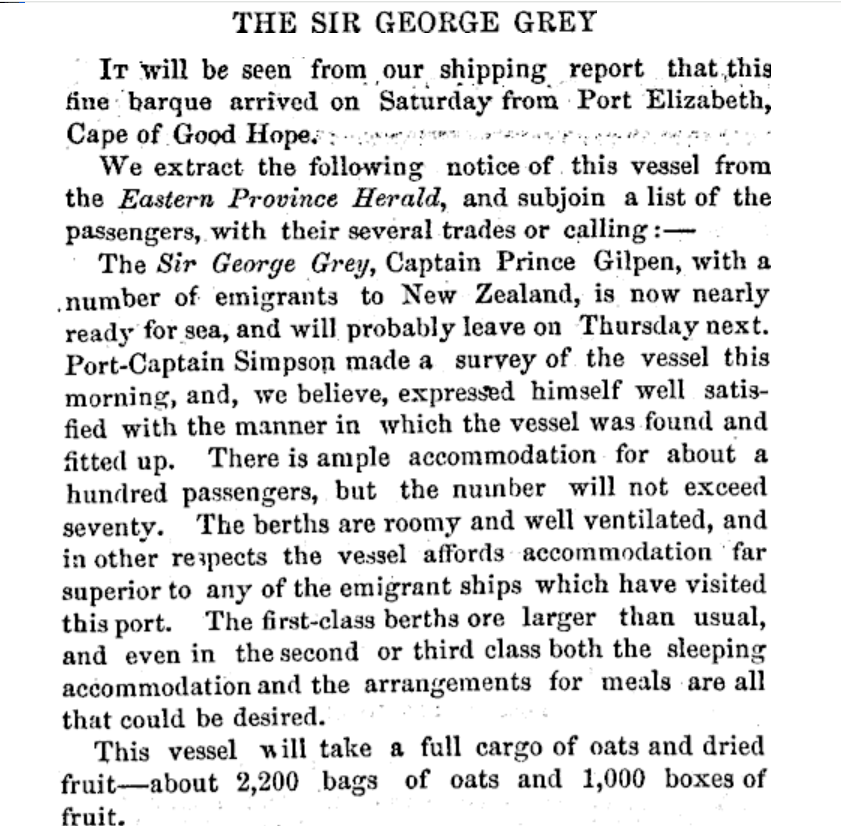
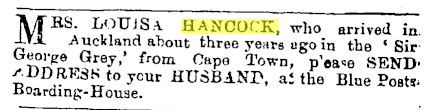
On the 23rd May 1864 Walter and Louisa would arrive in the busy Port of Auckland aboard the Sir George Grey. The ship had come via the Cape of Good Hope (Port Elizabeth) in South Africa. Their daughter Emma Sarah accompanied them. Walters occupation was given as a brick-maker. In the paper he was misprinted as William. (Papers Past, Shipping Intelligence, New Zealand).
New Zealand
Their next child Louisa Jane Hancock (b.1864, Auckland, (at the Auckland Immigration Barracks) has her own page on this site.
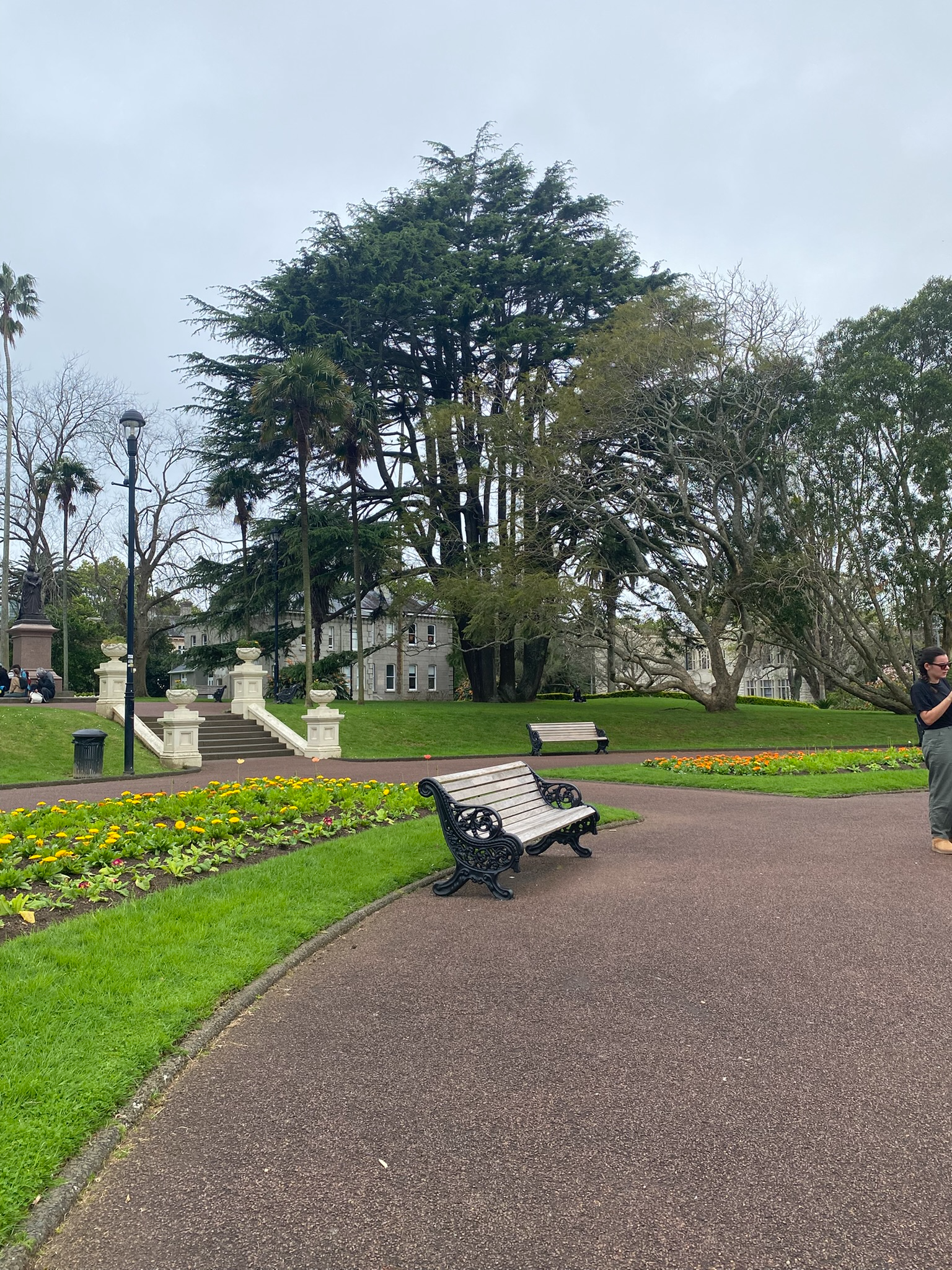
The Auckland Immigration Barracks were constructed as short-term housing predominantly for assisted passage immigrants who would come to Auckland between 1853 – 1868. They did continue to provide some accommodation up until 1870 for settlers but this was after the immigration scheme finished in 1868. Now a note about who was able to come as assisted immigrants to Auckland during this period. You had to be either a builder or in the construction industry or available for domestic service employment. Agents were located through Britain, Ireland (which was considered Britain at the time), Canada and Cape Town in South Africa. (Which incidentally is where our Hancock’s sailed from.)A small contingent of settlers also cam from Bohemia to New Zealand via Auckland under this scheme.
Arriving in Auckland at the harbour it was a walk up a rather sturdy hill for the settlers to what is now Albert Park in Auckland. In this same area was the Albert Barracks military installation. . Today the walk is a gentle clamber through Auckland’s trendy pavements and treelined streets to this beautiful hilltop location. At the time of arrival the Hancock’s would not have had this luxury and would have been grateful of the chance to rest and gather themselves upon arrival before being billeted to short-term accommodation.
Louisa Hancock born at the time her family arrived in New Zealand would marry three times in her life and live her life in New Zealand. Louisa would not have had a sense of being ‘of ‘New Zealand as both her parents, her community, her extended family were all English, or from Britain or Europe. It would be many years before the identity of Pakeha New Zealanders would separate from that of being “British subjects”.
Louisa Hancock would have ten children, all Whiteheads. When Louisa (Miss) wanted to marry for the first time in 1881 to John William Whitehead (registration 2616) it was her mother who was Mrs. Callan by that time who gave written permission for her sixteen-year-old daughter to marry. At the time Louisa was a servant in the house of Mrs. Whitehead who would then become her mother in law.
There was already a considerable contingency of Hancock’s in New Zealand before ours arrived. One of them was also a stonemason and whilst he is mentioned quite frequently, he is not our man. There was also another female Hancock who appears to have been a rather spectacular woman who was recorded by the courts as ‘committed’ to her drinking. Also not ours.
White Pioneering into Waipawa: (Central Hawkes Bay)
What became known by the Europeans as Central Hawkes Bay was previously a place prized by its owners the Maori people for eels and accessible freshwater via the Waipawa River. With Europeans came the acquisition of tracts of land from the Maori owners. Waipawa (pronounced Wy-pah-Wa) saw it’s first European landholders arriving from 1854 onward whose purpose was to acquire the land for farming. Frederick Abbott took up the first holding alongside the Waipawa river that would in time become the township of Waipawa. It was originally named Abbotts Ford or Abbotsford before being returned to it’s original name of Waipawa. In 1857 the first store was opened in Waipawa by Messrs Fitzgerald and Du Noyer. Not long after European settlers began to arrive and the establishment of a township began. Of course, this would bring business and tradespeople to the town. In the case of our Hancock family, it was trade and business in the form of a brickworks.
Initially settling in Motuotaraia, Walter and Louisa would soon join Louisa’s brothers family, William Hall and Ellen (nee Regan) taking up land near Waipawa in the Township of Sedgwick. Section No 1, block number 47, Patangata district. (November 1867.) Walter would set up a brick making and sales yard with a fellow brick-maker and settler, named T. B. Smith. The business was called Smith and Hancock and was located in their ‘yard’ next to the hotel, ‘Sedgwick Arms’. The Sedgwick Arms would be totally destroyed by fire on the 17th of August 1869.


It would be reasonable to believe that the bricks produced by Walter and his business partner were used in the construction of the township and nearby dwellings. Waipawa enjoyed a period of popularity with agricultural farms soon becoming common in the area. Whilst Waipawa enjoyed modest success in development of the Central Hawkes Bay region, it would undergo a sharp decline of occupancy in more modern times and remains presently a small township enjoying popularity with day-trippers and fishermen in this pretty rural locale. Many of the colonial buildings in the main street of Waipawa were reportedly taken down in the mid 1980’s due to disrepair, from being long abandoned. There is a mention of the Hancock’s at the Central Hawkes Bay Museum with Walter recorded as a ‘laborer.’ To date neither the museum nor the writer have had the opportunity to view/locate any of the bricks from the brickworks but the CHB team are very keen to secure one if possible to be curated into the Waipawa historical collection.
It was also in 1867 that a further daughter Elizabeth Hancock would be born at Motuotaraia. Elizabeth’s aunt Ellen Hall (nee Regan) was instrumental in assisting with her birth and became her godmother. Walter and Louisa’s last two children Harriet (known as Annie) and William were born in Waipawa in 1869 and 1870. Alison Clarke wrote in her book (2012, Born to a changing world) that in rural New Zealand European women giving birth at this time were fifty percent more likely to have a dangerous birth than their counterparts in the city and that one in eleven children would not live past their first birthday. She attributed much of this to the remoteness of access to skilled midwives or doctors. She wrote that in most cases when was help available, it was only the most straightforward of births that often local women were equipped to manage. Any complications or subsequent infections almost always resulted in an undesired outcome.
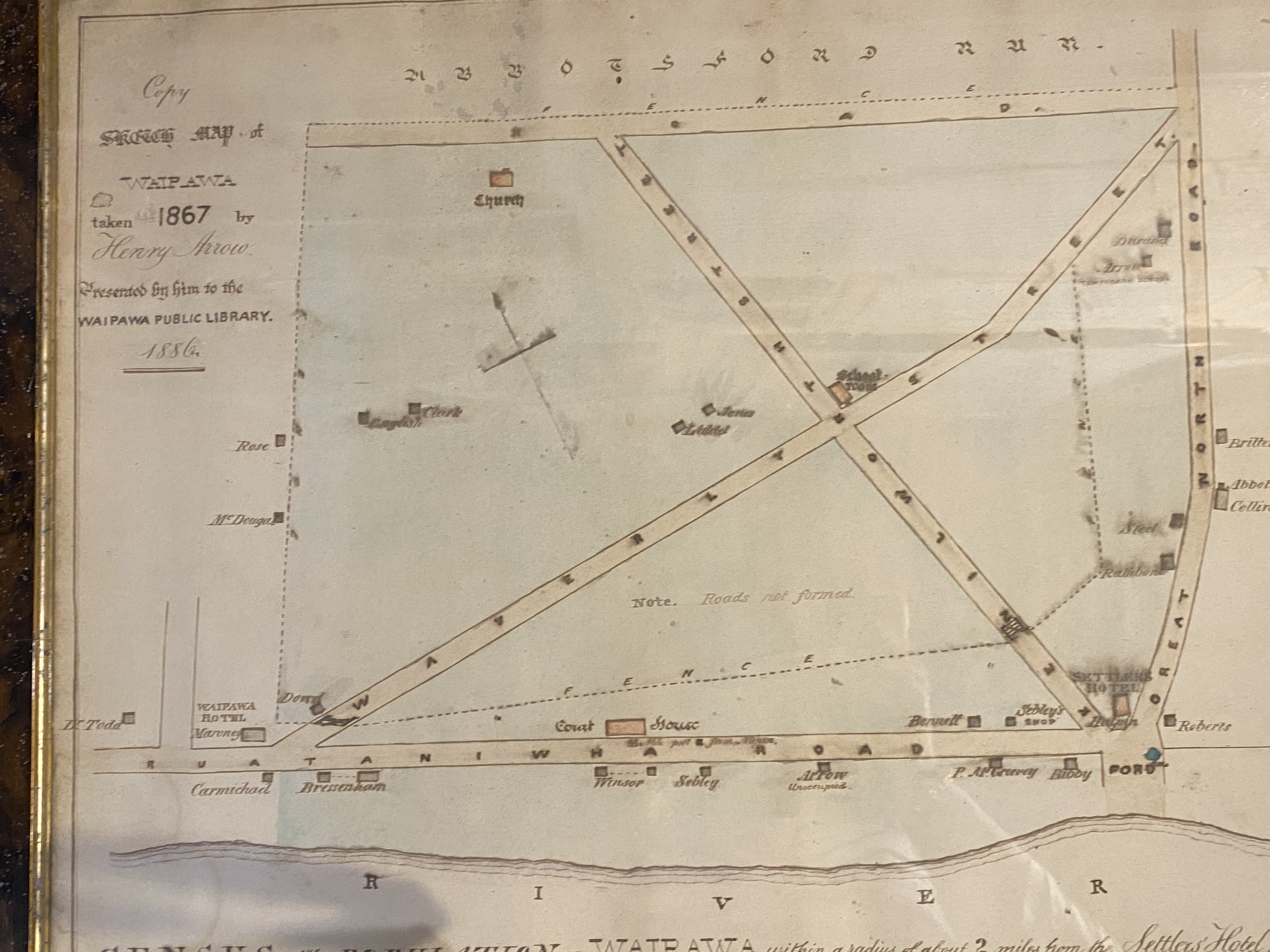
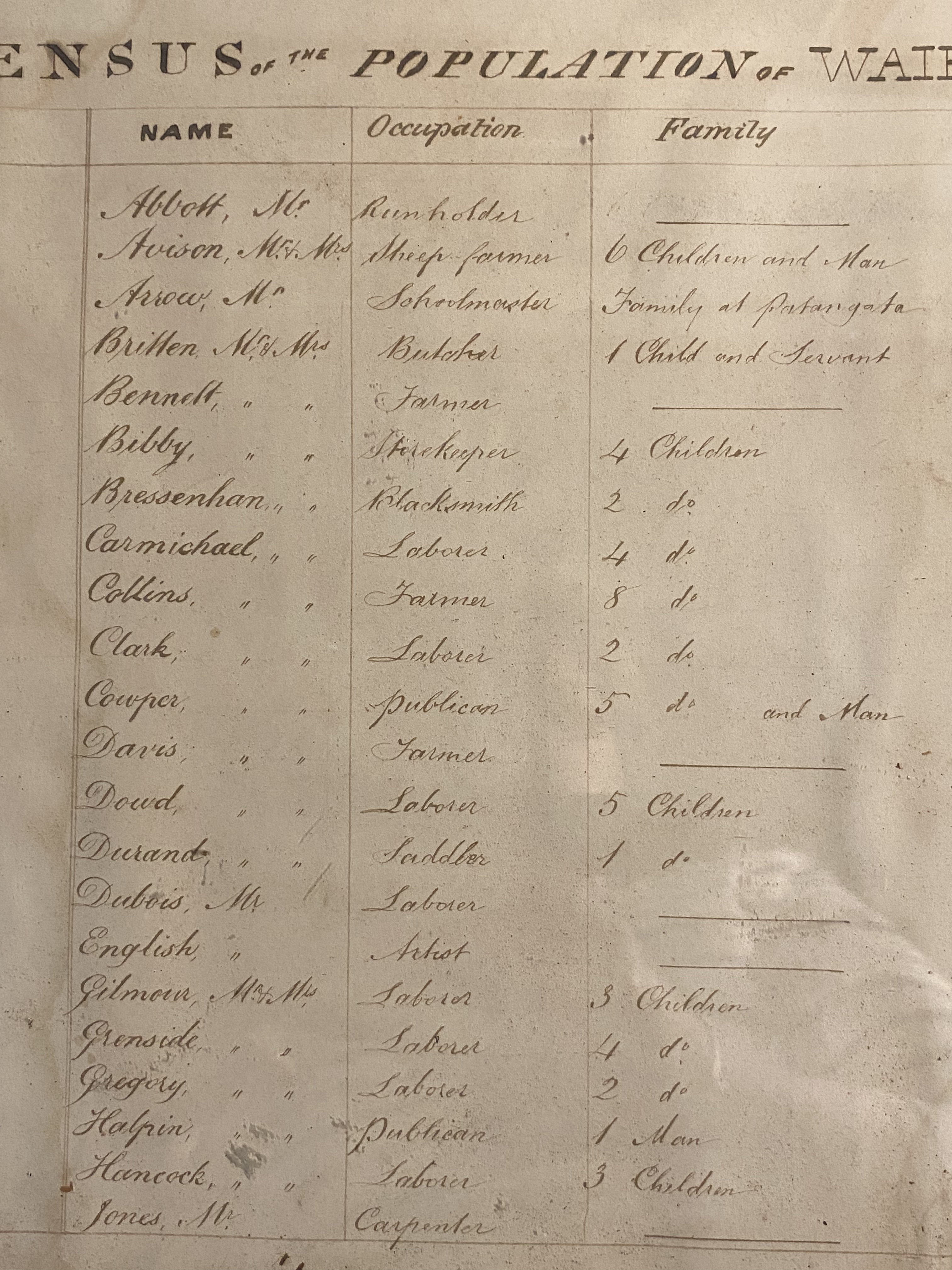
Central Hawkes Bay Museum located in Waipawa holds an original census and town map of Waipawa at the time that the Hancocks were residents. Noted on the census are the family with Walter’s occupation given as laborer.
HAWKE’S BAY TIMES, VOLUME 17, ISSUE 960, 7 MARCH 1871
Resident Magistrate’s Court.— This morning Walter Hancock, who had been brougt from Havelock some time since on a charge of larceny, was brought before S. Locke, Esq., J.P. Mr Scully said the prisoner was evidently a confirmed lunatic. In reply to a question by the magistrate, the prisoner began to mutter in an incoherent manner. He said he had been in prison five years, and had been kept without food all the time. —Remanded for medical examination. Beagley and Stevens v. Dempsey. —(Before S. Locke, Esq., J.l*., and J. G-. Kinross, Esq., J.P) —A disputed claim of 15s for lime delivered, which defendant maintained he had paid for. This case, after occupying the Court nearly an hour, was dismissed.
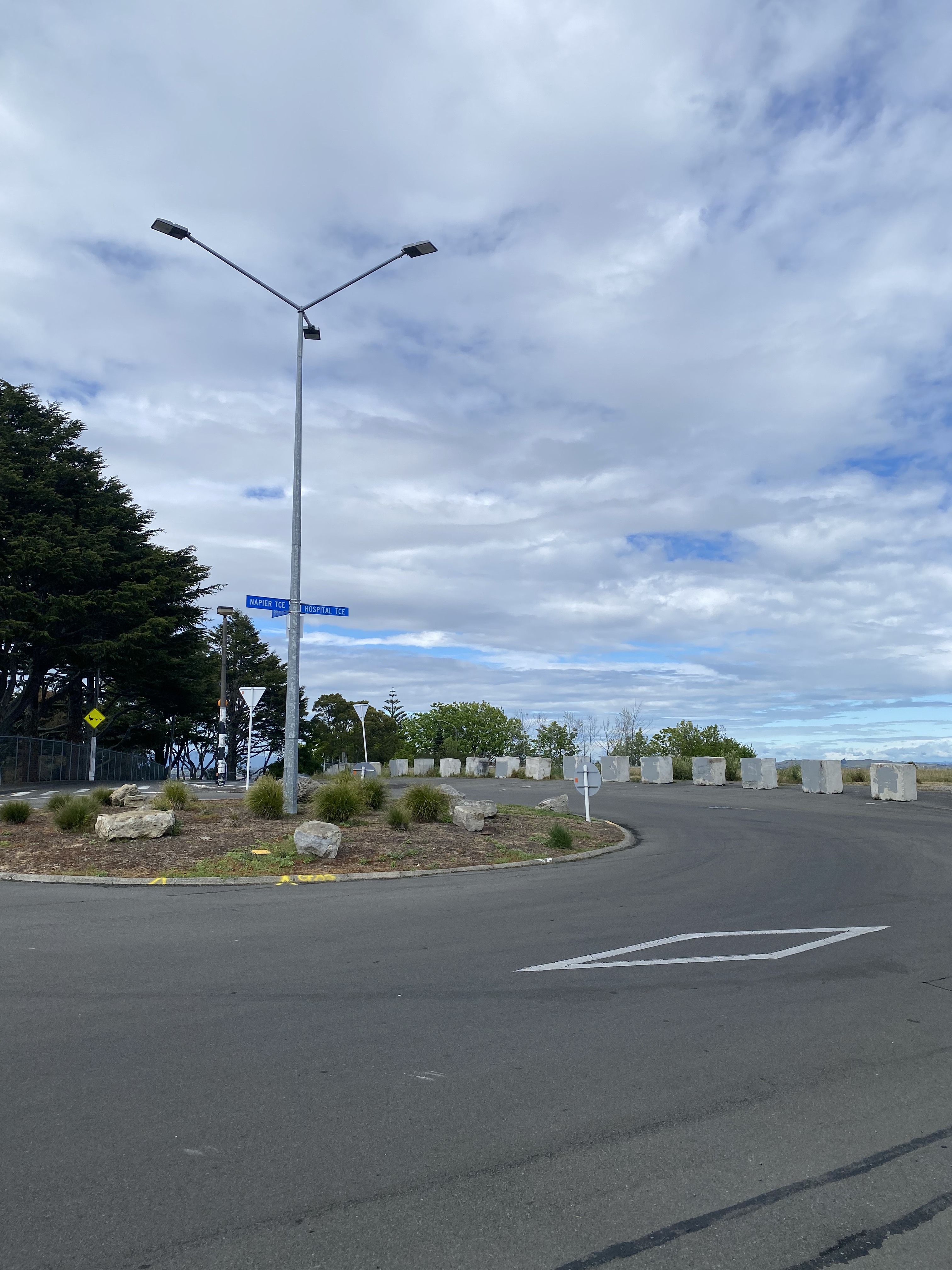
Walter died in Napier on the 7th September in 1871. Walter’s death was registered at the Napier Court House (reg 1871/1041). According to his certificate of death Walter died of a disease of the brain. There is very little information on this certificate, notably it does not even mention Louisa. To date, I’ve not been able to definitively locate a cemetery location for Walter. This could indicate that there is no headstone or marker available at the site of his burial. What I strongly suspect is that Walter is buried in the Old Napier Cemetery located on Hospital Hill in Napier. I know Walter had been in what we would now call psychiatric custodial care for several months before his death because of his ‘lunacy’, I know he died of a brain injury, I know he was no longer with Louisa. Whilst records for the Old Napier Cemetery have not provided me with a match yet, I’m confident this is the most likely place where his remains would be interred. Despite the records I am also comfortable that Walter was only 38 when he died. I walked the distance from where the hospital had once stood on Hospital Hill in Napier and it was a short direct route downhill to the cemetery.
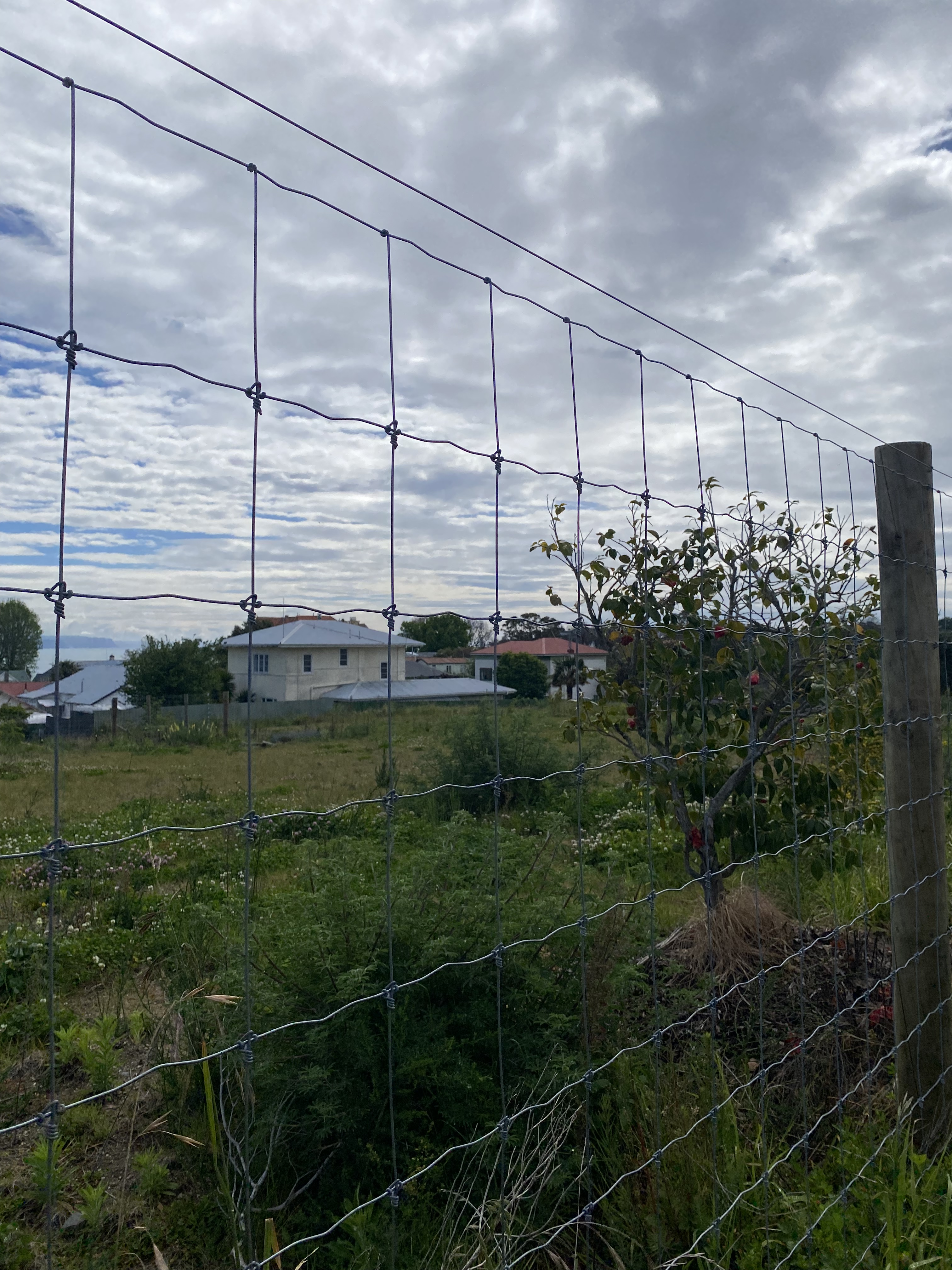
Children of Walter and Louisa Hancock
Walter and Louisa’s eldest child Emma Sarah Hancock (b.1860, Port Elizabeth, South Africa) would marry a fellow immigrant to New Zealand in Giuseppe Giovanni Donghi (known as Joseph). Giuseppe had hailed from Vittoune, Milan in Italy. They would live around Waipawa and have a very large family. Emma died in 1937.
SHANNON NEWS. HOROWHENUA CHRONICLE, 3 JANUARY 1931 The death occurred at Waipawa on Christmas Eve of Mrs J. Donghi, one of the pioneers of that district. The deceased lady, who was well-known and respected, had reached the age of 70 years and was the mother of eighteen children, eleven of whom and her husband survive her. The daughters are Mrs S’. Bennett .(Shannon) and Mrs R. Broadbent (Takapau), and the sons Walter (Te Awamutu), Robert (Otane), George (Ormondville), Alex. (Puketitiri, H. 8.), and Albert, Charles, Jack, William, and Ernest, of Waipawa.
The next child Elizabeth Hancock (b.1867, Motuotaraia, NZ) was only four when her father died and may not have remembered him. She married John William Pollington in 1885 (registration 1527) and lived in NZ. Elizabeth died at the age of fifty in 1915.
RANGITIKEI ADVOCATE AND MANAWATU ARGUS, VOLUME XLI, ISSUE 11312, 3 AUGUST 1917. The late Mrs Elizabeth Pollington died on July 28th, after a short illness at the age of 50 years. She leaves a grown up family— Mr Charles William Pollington, Fern Flats; Mrs 0. Monro, Wanganui; Mr A. C. Cooper, Wellington, and four grand children— to mourn their loss.
Harriet (Annie) Hancock (b.1869, Waipawa, NZ) was a two year old at the death of her father. She later married James Lord and lived in NZ.
William Thomas Hancock (b.1870, Waipawa, NZ) was not even a one year old when his father died. William would later be a witness in the proceedings of divorce for his sister Louisa Whitehead and worked with her helping her to run the boarding house.
Louisa began a new relationship with Thomas Callan a brick-maker. They would marry 8th of June, 1874 (where she was recorded as Handcock by the registrar, registration 7834)).
Thomas Callan had been married to his first wife Mary, with whom he shared seven children. Home for the Callan family had been Wellington south of Waipawa by some considerable distance. Mary Callan died in 1874.
Twin girls were born in 1872 to Louisa Hancock. Walter died in Napier in a hospital for the mentally unwell in 1871.
Children of Louisa and Thomas Callan
There were twin girls born in 1872. Their surnames were given as Hancock-Callan and on the birth certificate, their father’s name listed as Thomas. Catharine one of the twins died in 1872. Her twin Mary-Ann Hancock-Callan would marry Michael Finlayson-Stirling in 1888 (registration 2949). The Finlayson would be dropped and a very large family of Stirlings would follow. Like her daughter before, Louisa (Callan) gave written permission for her sixteen-year-old daughter Mary-Ann to marry Michael Finlayson Stirling.
In 1876 in the intention to marry register Thomas Callan is recorded as Step-Father to Emma Donghi who is recorded to marry Guiseppe Giovani Donghi in the Waipawa Catholic Chapel.
A third daughter Hannah Callan was born in 1877. She would be raised after the death of her mother when she was aged 10 by her sister Emma Donghi. Hannah would marry Francis Charles Young.
Thomas would appear in the Wanganui Chronicle (paper) in the lists of people who were qualified to serve as Jurors for the towns of Wanganui and Turakina and District of Wauganui (1860 and again in 1861). Thomas was listed as a Brickmaker. Later in life he would continue to give his occupation as Bricklayer in official records.
Married life for Louisa with Thomas appeared to have been an unhappy one. Thomas known as Bricky (no doubt because of his occupation as a brickmaker/layer) was not only frequently having run ins with the law including being sentenced for imprisonment. He was remarked as being violent toward his wife, as recorded in 1881 where he was jailed over a domestic assault.
On July 20, 1881 Thomas who resided in Waipawa and was remarked as a native of Ireland was tried in Waipawa and sentenced to twelve months of imprisonment in Napier Gaol because of default of bail with a conviction of assault. He was recorded as having been born in 1830 being 5″10 in height, dark mixed with grey hair, grey eyes and that he had one previous conviction.
Resident Magistrate’s Court, Waipawa
Louisa Callan applied also for a protection order against her husband, Thomas Callan, on the grounds of habitual drunkenness and cruelty. Mr Guy appeared for Mrs Callan. The applicant stated that she had received only (1 pound) from her husband since Christmas towards the support of her and her four children. Callan came home drunk every night and repeatedly turned her and her children out of the house, one time threatening to take her life with a trowel. Applicant had to call in the police frequently to protect her from her husband. Seargeant O’Malley deposed that Callan was a very bad character, and had been convicted several times for larceny, drunkenness, using threatening language to his wife and he rarely knew Callan to do any work. Constable Brosnan deposed that he had frequently seen Callan drunk and had twice locked him up. Witness had often been called in by Mrs Callan in consequence of quarrels. On one occasion he found all the windows and doors of Callan’s house nailed up and a quantity of wearing apparel thrown outside in the yard. The Bench granted Mrs Callan the protection desired.
Waipawa Mail, Volume 5, Issue 472, 23 March, 1883.
Judicial – On Saturday last before St C. Inglis, Esq, J.P. Thomas Callan was charged by the police with annoying and threatening his wife. Mrs Callan obtained a protection order on Wednesday last and on the evening of that day Callan went home and behaved in such a manner as to necessitate his being taken in charge. Defendant was bound over to keep the peace for six months, in two sureties of (10 pound) each and his own in (25 pound) or go to prison for that time.
Waipawa Mail, Volume 5, Issue 473, 27 March 1883, Page 2
He had a further brush with the law when in 1886 he and a mate John Day were charged with being ‘drunk and incapable’.
DAILY TELEGRAPH, ISSUE 4625, 3 JUNE 1886. At the R.M. Court, Waipawa, to-day, Thomas Callan (otherwise “Bricky”), and John Day were charged before Mr S. Johnson, with” being drunk and incapable. After being – strictly cautioned, they were each fined 5s, with 2s costs, or 24 hours’ imprisonment. The fines were paid.
Court News – At the local J.P. Cout on Wednesday, 20th Thomas Callan (better known as “Bricky”) was charged with assaulting his wife Louisa Callan on the 18th inst., by striking her on the mouth with his fist. Prisoner’s wife proved the offence, and Callan was sentenced to two month’s imprisonment with hard labor in Napier Gaol. The same prisoner was also ordered to find bail, himself (50 pound) and two sureties (25 pound) each, to keep the peace towards his wife for twelve months on the expiration of his present term of imprisonment, witness having laid a second information to the effect that she lives in constant bodily fear of him. – Waipawa Mail, Volume 3, Issue 299, 23 July 1881. Page 2.
In 1885 Louisa who was recorded as Louisa Callan was recorded as the witness to intention to marry for her daughter Elizabeth Hancock, aged 18, employment domestic to John William Pollington. In the record she is recorded as step-mother which is bizarre.
A Mrs Susan Callan died in 1887 also (bet 21-23 July), and it is easy to get the two confused. Susan was 65, died in her sleep in bed at her home The Waverley Hotel, and was from Greymouth. Her registration number (4043), a different lady entirely.
Louisa died 26 June, 1887 (registration 2286) at the Waipukurau Hospital in Waipukurau, Hawkes Bay. The hospital was only quite new having been opened eight years beforehand in 1879. Sadly this hospital no longer stands only being ruins. Louisa’s age at death was given as fifty five years. She was buried 28 June 1887 at the Waipukurau Cemetery. 1592 Block Old. plot 384 Mrs Louisa Callan buried 28 June 1887, no headstone. In Oct 2025 some robust searching of the Waipukurau Cemetery has enabled us to establish Louisa’s resting place.
From Footsteps of a Pioneer – A Hall Story, Rae Nicholls, (1982). (available at Auckland Library by prior request for reading access. Accessed by author, October 2025)
Louisa died aged 55 of cancer at the Waipukurau hospital 26th of June 1887. Of her six daughters Emma, Louisa, Elizabeth, Harriet (Annie), Mary Ann and Hannah, Louisa asked her eldest daughter Emma “If you take care of the two little ones, (aged 15 and 10) I’ll die happy”. The girls were taken into the care of their older sisters and raised in their family.
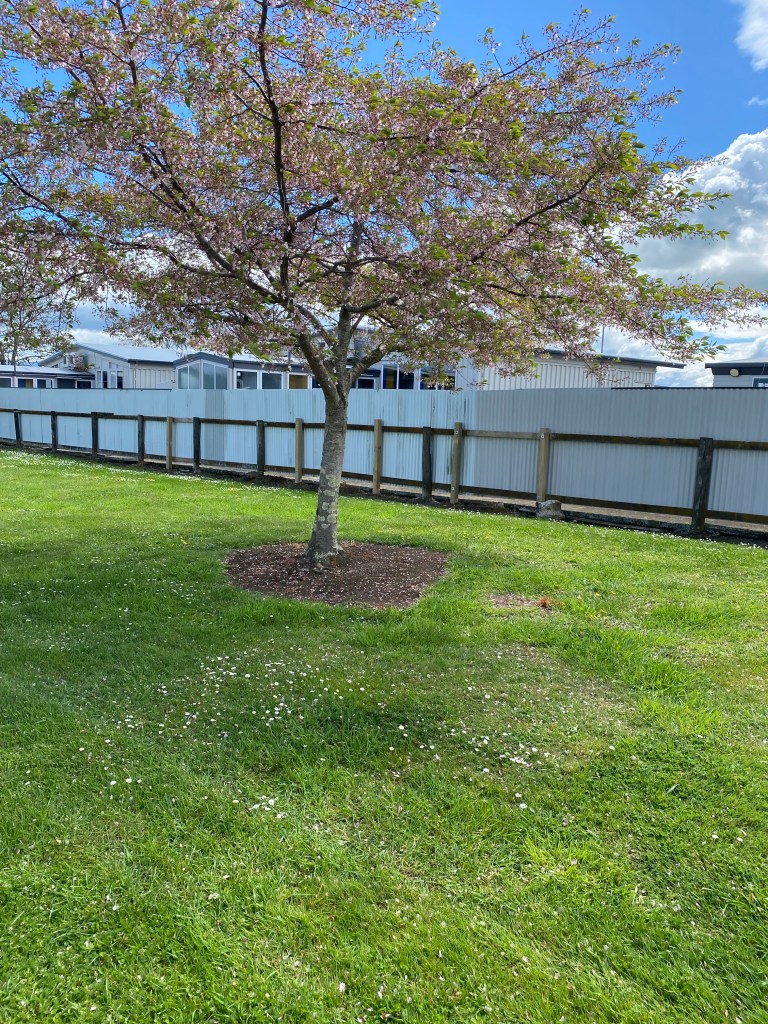
Waipukurau Cemetery October 2025, Louisa Hall, Hancock, Callan, Author’s photographs.
Thomas “Bricky” Callan remained in Makotuku, Waipawa (electoral rolls) and lived on until 1909 dying in the local area as an 80 year old man. He would have three separate stints of incarceration in Napier Prison two before and one after Louisa’s death. It would be reasonable to conclude that from 1883 onwards Louisa and Thomas would have lived entirely separate lives. At this time of final separation their youngest child would have been aged four.
 Yews to Eucalypts