
Richard Coverly (spelling can vary) lived a rather short life of forty one years. Born to Richard Coverly (snr) and his wife Sarah on the 2nd of October 1755 he was baptised on the 26th October 1755 at St Giles Cripplegate in London, England. A sister Alice would be born in 1758 but would die still a child in 1767 caused by what was remarked as fever. Richard was aged twelve at the time. A younger brother Thomas was born in 1761. There may well have been other children, I’m just not able to say with certainty at the moment. Smaller families were the exception.
Richard become a Cordwainer (maker of leather shoes,)Cordwainer like his father Richard Snr before him. A respectable, skilled trade in the hustle and bustle of eighteenth century London.
At the age of twenty-four bachelor Richard married young twenty-six year old widow Jane Flintoff at St Botolph without Aldersgate in London.
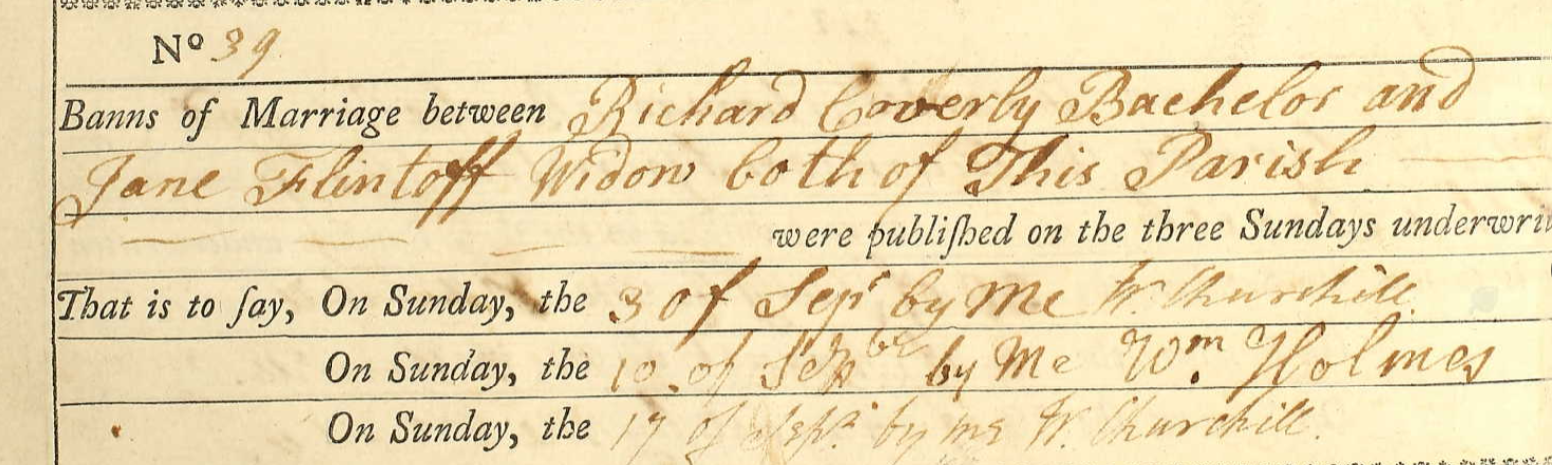
Jane Flintoff nee Gilling was a fellow local Londoner whose first husband John Flintoff had died the year before in 1779. They had been married about six years. Jane herself would die a few years later @1789 leaving Richard Coverly a widower.

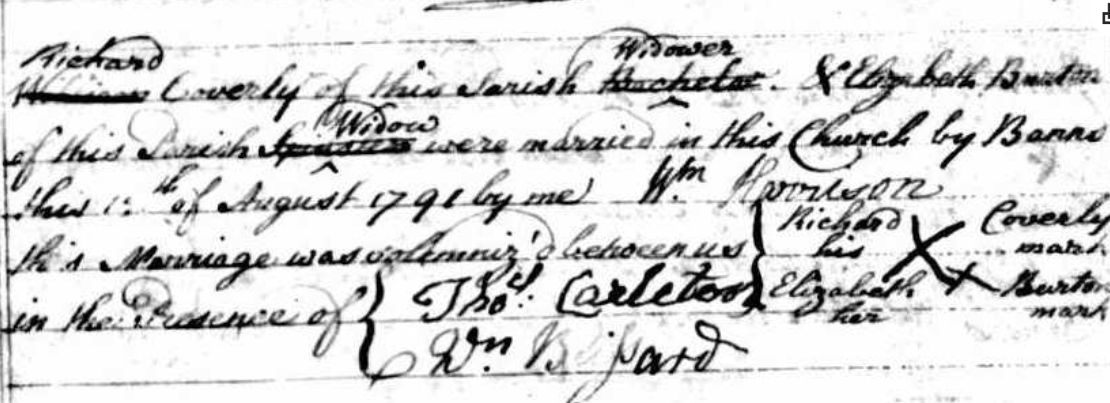
In August of 1791 Richard married again this time to our progenitrix Elizabeth Burton. Elizabeth was a widow. Neither Richard or Elizabeth could read/write with both leaving X as their mark on the marriage register. The marriage took place Saint Luke Old Street, Finsbury, London.
The following year in 1792 at the age of thirty-one Elizabeth gave birth to their daughter Maria Coverly. Richard was thirty-six at the time. It does seem unlikely that between the marriages that there were no other children of the unions, but to date I cannot say for certain other than Maria.
I’m proposing that Richard, Elizabeth and Maria were living in the general area or Clerkenwell. A location known to be inhabited by tradespersons and among them Cordwainers. Also an area that had an active ‘Skin Market’ which would not be closed till 1815. Nothing salacious here, merely where animal hides, predominantly sheepskin were sold. This would have been where the Cordwainers purchased materials to make leather footwear. From 1707 through to 1821 this was a densely inhabited area packed tight with housing, servicing a busy community. Clerkenwell had been an ancient village on the outer rural edges of London prior to expansion eventually encompassing it where it became part of the Borough of Islington.
A few short years later Richard would die aged forty-one. He was interred at the Spa Fields burial ground a few days before Christmas on the 18th of December 1796. St James, Clerkenwell, London, denomination was recorded as Countess of Huntingdon Connexion. Countess of Huntingdon Connexions was a Methodist movement established in 1779 by their founder the Countess of Huntingdon who bought the lands and built a chapel. The Spa Fields location was originally conceived as a central meeting place with an accessible chapel for the evangelical faithful plus affordable burial for up to nearly two-thousand souls of the non-conforming faith. By the mid 1840’s Spa Fields burial ground descended into a squalid pit of festering ad hoc burial and reburial with existing graves both new and old being regularly desecrated. Body parts of the deceased being disposed of most gravely and with utter disregard. The respectful chapel and grounds Lady Huntingdon had envisioned would become a place of extreme disrepute and horror with authorities finally closing it permanently in 1849 with a figure of approximately eighty-thousand largely unidentifiable souls being interred there. Reffell family history (Spa Fields Burial Grounds. At the time of closure it was remarked not a single headstone stood to honour the dead. Lady Huntingdon’s Chapel would be removed in 1888 with a still existent Catholic church built in its place. In 1885 the grounds were purchased by the London Council who turned them into a children’s recreational playground.
Richard (and very likely Elizabeth also) were members of the Lady Huntingdon’s Connexion parishioners of Islington. For want of a better description. the Connexion were a Calvinistic inspired splinter of the Methodist Church founded by Lady Huntingdon with a particular focus on veneration and adherence of the gospel to guide day to day living with a focus on the message of Jesus being readily available to all people not just via a clergy. Lady Huntingdon established several chapels of worship in Britain with her main one being at Spa Fields where she also chose to reside later in life. The Countess of Huntingdon & Gospel Ministry – Marg Mowczo
When Richard died Elizabeth was only thirty-six. A search of the available Non-Conformist Registers has not provided me with any further concrete evidence of what became of Elizabeth after Richards death. The possibilities until proven are many. Elizabeth could have remarried. She could have died young. She could have moved away. I’ve not been able to find her in the 1841 census as Elizabeth Coverly so really can’t say.
What we do know is that some years later, aged twenty-one their daughter Maria Coverly, unmarried, employment given as ‘servant’ was only a few mile away from her childhood home stood at the bar of the Old Bailey charged with larceny. The outcome would be incarceration at Newgate Prison (1813) awaiting transport to the Australian colonies. Sentenced to seven years soon Maria would leave England never to return.
 Yews to Eucalypts