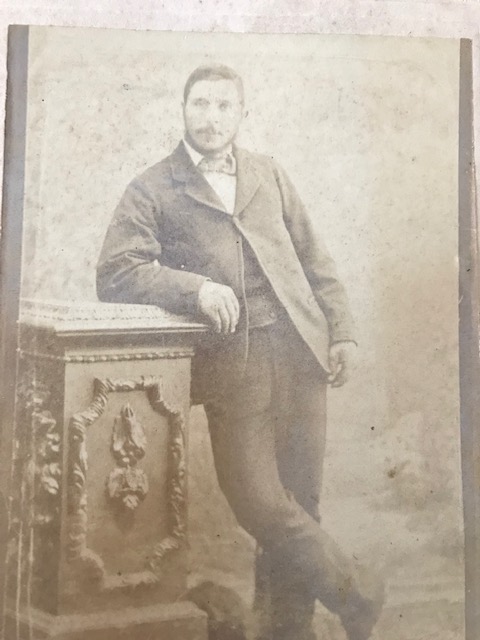
John Larkin, (we will get to the Lorkin bit directly), was born in Ireland in what is now known as the County of Offaly in the village of Ferbane. John was the son of Michael Larkin a farmer and Mary Cantwell of Kilcolgan a small agricultural area to the near east of the small rural village Ferbane, located in the Irish midlands. At the time that he was born the County was named Kings County. Whether Michael actually owned any of his own land or whether he was an agricultural labourer on a landlords property? I am not yet sure. John was baptised on the 5th March 1828. This information was gained from the church records at St Mary’s Catholic Church in Ferbane. His godparents were recorded as Michael Cantwell and Mary Larkin. We can assume that Michael Cantwell was a relation to his mother, possibly a brother? John’s year of death later gives estimates his birth year as 1830 but I don’t think that is right.
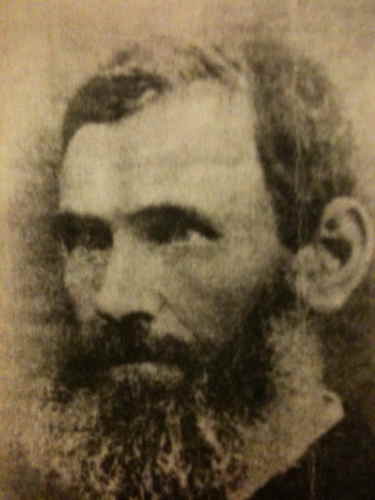
John’s parents had married in Ferbane on the 14th June 1823 in St. Mary’s Catholic church in Ferbane. John’s brother Michael was born in 1830 and recorded in the same church.
Ferbane hugs the north bank of the river Brosna. Nowadays the County containing Ferbane is Offaly. However, in John’s time it was Kings County. We were told that my Nana’s grandfather had come from Kilcolgan near Ferbane. The Kilcolgan of family lore being a small agricultural area a little to the east of Ferbane village. In Ferbane there is a Cantwell Street and also a good representation historically of Cantwell’s and Larkins. These are the original families our original Irish Lakin ancestors.
At the same time Kings County which appears to have had a concentration of the Larkin name also had its share of poor souls caught up in the wretched practice of transportation to the Australian colonies for crime. Much of what we would nowadays consider petty in the sense that people were starving and trying to feed their families. I’ve been able to locate records for the following Larkin’s of Kings County whose fate fell this way. Elizabeth Larkin of Kings County aged 22 was tried for larceny on the 1st of July 1847. She was sentenced and transported to Australia (Tasmania) for seven years. Elizabeth instead died at Grange Gorman Penitentiary in great pain of a kidney or liver illness at the age of 22. She remarked that she had been in hospitals in Ireland prior to being imprisoned. Her death occurred shortly before the convict ship she was due to be transported on (The Kinnear) embarked. James Larkin aged 28 of King’s County was tried and convicted of malicious assault on the 3/3/1836, and was imprisoned for one year and sent to Australia, seven years transportation. Mary Larkin aged 34 of Kings County was tried and convicted on the 25/10/1836 for larceny and transported to Australia for seven years. She was detained at Kilmahain Gaol in Co. Dublin from the 15/11/1836 before arriving in Australia aboard the Margaret in January 1837. Mary was able to gain her Ticket of Leave in 1840 and lived in Windsor NSW. Patrick Larkin aged 42 of King’s County was tried and convicted on the 21/7/1848 of cattle stealing and was tried and sentenced to seven years. He would never leave Ireland being imprisoned at Spike Island Prison off what was then Queenstown (Cobh) where he died 22/3/1854.
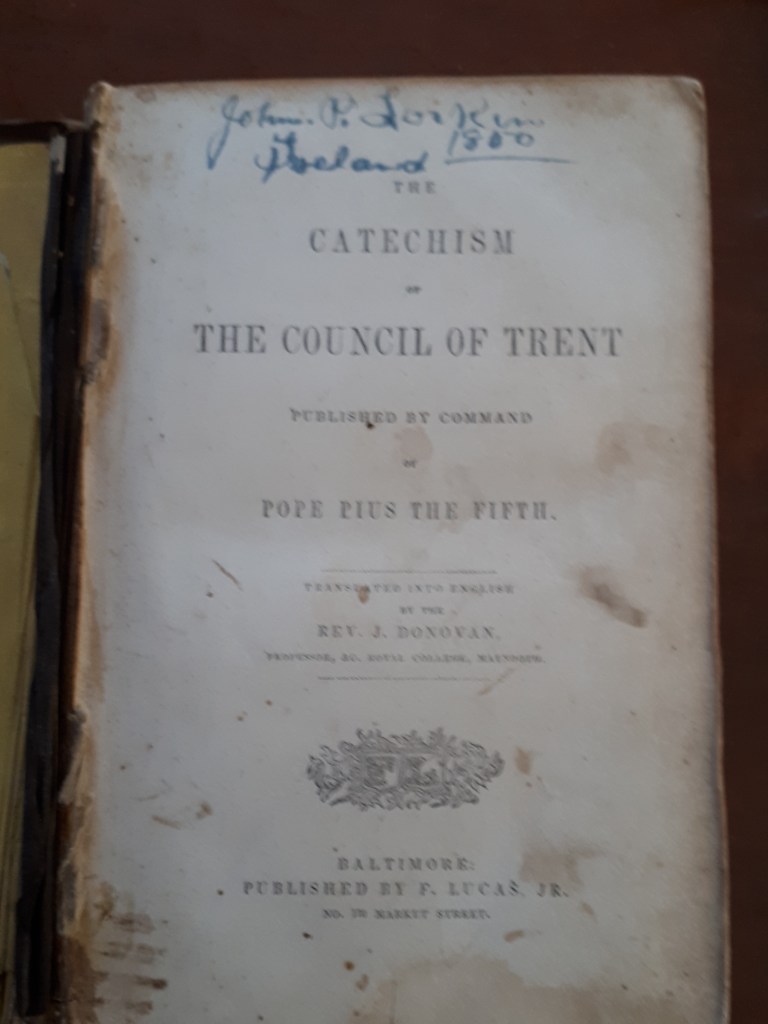
I know that John had a brother Thomas who stayed behind in Ireland after John and his brother Michael emigrated. John to Australia and Michael to America. The Australian branch are the only ones who changed their name to Lorkin (which to today is the recognised current spelling).
Michael emigrated to America and appears in the census in 1854 Monroe, in New York. Through the very great kindness of an American cousin of ours, we have been provided a generous transcript of a letter that John wrote to his brother Michael from Australia.
——————————————————————————————————————–
Melbourne
228 King St
May 15th, 58
Dear Brother,
I received your letter this day which gave me great consolation to hear from you and which I now hasten to answer. I understand by your _______ you would like to go home to see your father and afterward come out here. I agree with you in that view for if you come here, you shall never again see your dear father. Should you go home the sooner you do the better.
Don’t forget writing to me when you land in Ireland you can use your own digression as to how long you intend to stop at home. I can see that your wages in America is about (28 and 2) per week and found withal.
I will say that your yearly salary to be 150 for perhaps 60 (?) But recollect you will have to pay out of that for washing, mending, etc. Now dear Michael if you should go to Ireland, I hope you will not stop long there if you intend to come here for the sooner the better. The passage money from Ireland to Australia is at present to this place (20 pound) so that for you to go home would not increase any additional expense so you can do as you think proper.
Dear brother I am doing tolerably well but I have a hard employment. I am up two nights in the week to attend the market, yet my wages is 30 per week and found but I have to pay for washing, mending, etc which comes expensive. I received a letter from my father about two months back he’s quite well and doing well. He wrote to the same effect as you and he would be glad that you would be out here with me. My father thought that I could get you out by the Immigration Aid but I could not. No single young man would be taken. I am glad to hear from Mr. Hemmafy and ________ I them say beat _____ also to the enterprising friends no more at present. From your affectionate brother,
John Larkin
Michael Larkin
State New York
——————————————————————————————————————–
A valuable insight to how our John was doing upon arrival in Melbourne. John was still a single man at this time it would appear given his references to washing and mending – a wife would have taken care of these tasks. Where he was living at King Street is right next to the historic blue-stone building that was a warehouse and is now the Colonial Hotel. When John was in Melbourne city, there were markets of different types around him. The famous Queen Victoria Market or “Queen Vic” to we Melburnites, did not open until 1878. It’s not surprising that the cost of living for John was so expensive in Melbourne. 1851 heralded the boom of the ‘gold rush’ and diggings had broken out across Victoria in earnest. Melbourne was in the grip of her first time as a boom town. He is right in what he says about the assisted immigrant/bounty program. To be eligible a man needed a wife and preferably a young family and to be of younger years to be considered. The colonies had quite enough single men and were keen to populate the land with what were considered hard-working, church-going families who would bring trades and respectability to what was considered a rabbling settlement of convicts and rough men a mere generation prior.
By 1860 things must have improved for Michael as he stayed on in the U.S. and married a widow Elizabeth Hosey in 1860 and finished out his life living in the U.S. becoming naturalised in 1861 and dying an old man in 1906.
I have covered John’s brother’s and his parents story more broadly on a separate page that you may wish to read on this website. Michael Larkin and Mary Cantwell.
——————————————————————————————————————–
Mary Donovan from Cork.
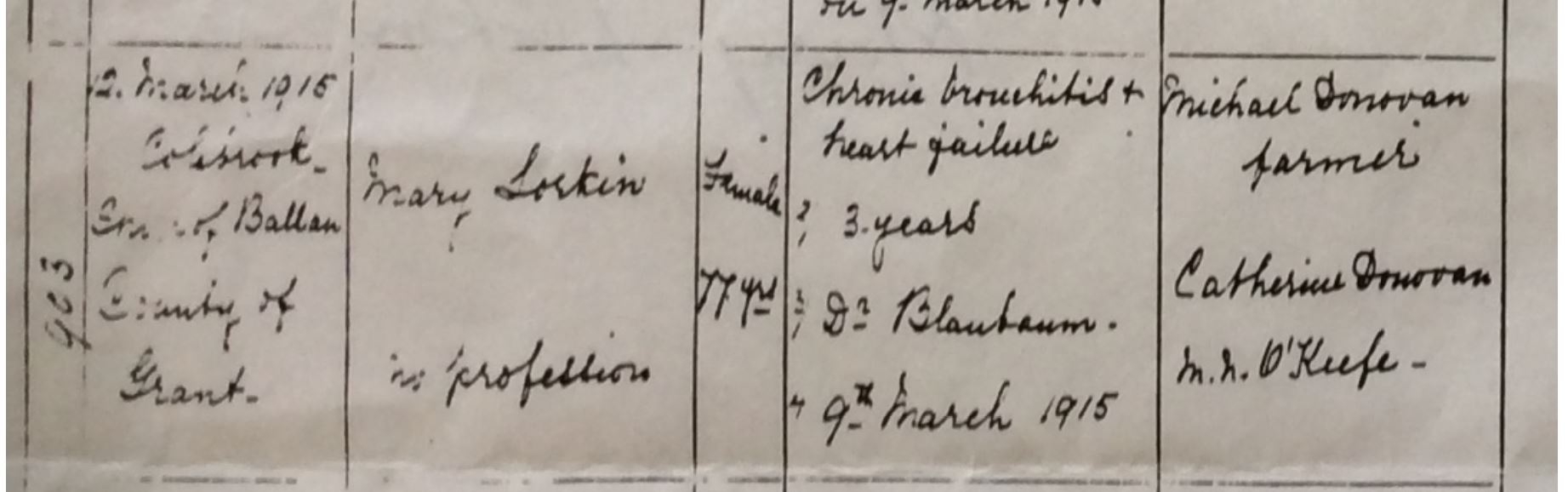
Mary Donovan’s precise circumstances pre-empting her decision to emigrate to Australia has proved to be challenging. Mary reported herself a native of Cork and this was something I was always told by my grandmother about her grandmother so being able to fit these pieces together with evidence has been gratifying. Specifically Mary was actually a native of nearby Cobh. In 1849 the name was changed temporarily to Queenstown (per Queen Victoria), before being restored to it’s proper name in 1922 after the establishment of the Irish Free State. Prior to this time all Irish were considered subjects of England with English government ruling the country. Cobh (pronounced Cove) is indeed considered part of the City of Cork and having spent some time there in November 2024, I can attest that it is only a short and comfortable drive from the city centre of Cork. The names Donovan and Keefe (Mary’s mothers surname) were prevalent names in the Cobh area of the time where I have found them frequently repeated.
On her daughter (Lilly Mary’s) birth registry information (which I’ve purchased), I can see that Mary gave her place of birth as Queenstown, Cork, in Ireland and that she was aged 25 when Lilly Mary was born (in Australia).
It is very probable that Mary came aboard the Negotiator which left Liverpool England in March of 1857 arriving in June of 1857. A couple of things support this. Mary and her brother Daniel lived near to each other all through their years in Australia and I was always told that they were the greatest of friends, that Daniel was someone who had ‘looked after his sister’ when they were younger but not much more about that statement is actually known. Mary is recorded as a single woman leaving Ireland and on the same records of the Negotiator is Daniel, a single man, an agricultural labourer. The years of birth that are a little off (age wise) do fit better with what is on the shipping records and the records provided for marriage. Both Mary and Daniel Donovan were recorded on the ship register as assisted immigrants who sailed from Liverpool. Which is interesting because if the Donovan’s had still been living in Cobh, Cobh is where many of the emigrating Irish departed, however, this is not likely in the case of Mary and Daniel.
While many of the Irish diaspora at the time and in the years during and immediately after the famine did sail from County Cork, there were significant numbers who in the years following 1851, were supported in great numbers to leave Cork and West Cork County (which had endured a particularly devastating impact from the famine.) Indeed these post-famine years emigrants were being firmly encouraged some may even say somewhat forcibly, by government agents for the landholders (the latter who who wanted agricultural tenants/subsistence tenants off their land due to poor law tax reform) to go to Liverpool to join ships leaving for Australia, and in particular Melbourne.
During the famine years from 1845 through to 1851, the first place where the majority of the emigrating Irish were being directed, was the United States. This is precisely where Mary and Daniel’s brother Michael Donovan would emigrate to. He would live the remainder of his life, marrying, having children and establishing a Donovan family in and around Boston, Massachusetts. The reason that I think it is most likely that Mary and Daniel Donovan fitted into this latter group is that years later their father’s occupation was recorded as a farmer. This would fit in with the Donovan’s probably and most likely having been what was then subsistence farmers usually always tenants on the land of a wealthier landholder/gentry to whom they would pay rent. It is extremely unlikely that Mary who gave her occupation as a domestic servant and Daniel as a labourer, would have had any ‘means’ if their circumstances had been anything other than basic working-class. It is probable that Daniel may even have worked on one of the many government funded roadworks during the famine to try and make some money. Mary I’m going to suggest was born anywhere between 1837 to 1840 this is proving quite difficult to lock in. On Lilly Mary’s birth registration she gave her age as 25 which would suggest 1838.
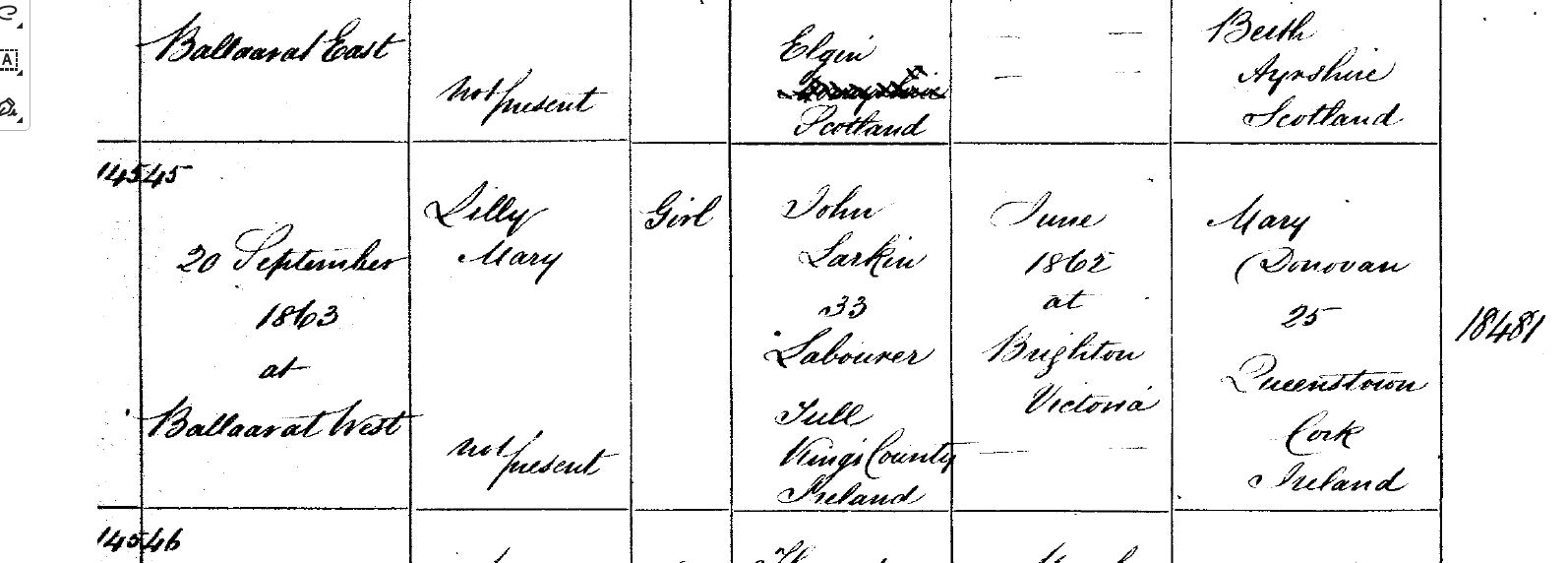
Mary was some years younger than her brother Daniel (probably 1823) and younger than Michael. As to other siblings, I cannot yet say. Mary would have been a child during the famine and at best between 17 and 22 years of age when she came to Australia. Mary and John recorded on their daughter Lilly’s birth registration that they had married at Brighton in 1862 the year prior. We know that is not accurate as they were formally married many years later in July 1893 At the time of Lilly’s birth both Mary and John were residing in West Ballarat.
Daniel was working with his brother in law John Lorkin and Mary’s family at Ballanee near Ballan, Victoria and was an employee there for some time. Daniel as I understand it did not marry instead staying close to his sisters family his whole life. Daniel Donovan died in Ballan in 1900 and is buried not all that far from his sister and brother in law in Ballan New Cemetery.
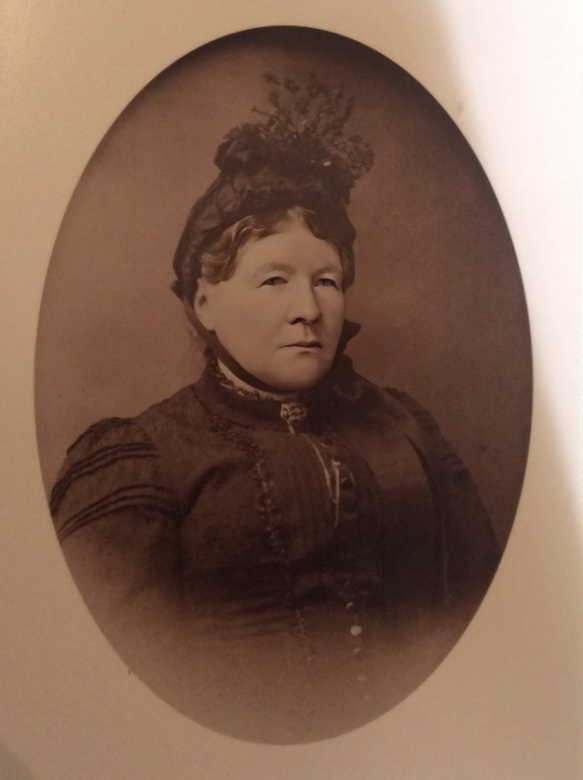
Mary and Daniel’s other brother Michael Donovan also left Ireland and emigrated to the United States settling in Boston Massachusetts.
Leaving Ireland;
I believe the most reasonable assertion is that John came to Australia, via Liverpool England aboard The Miles Barton with the ship arriving in Melbourne on 13th of August 1855. John was an unassisted passenger, so would have paid his own fair or been sponsored. He is recorded as English, however, I think that is a clerical error as the person above him is ticked as Irish. So I think just a transcription error. John travelled in steerage and was recorded as a laborer. The age also lines up with him recorded as 26 years.
Why John came to Australia I suspect can be easily reasoned; life in Ireland was particularly challenging The great famine (potato) between 1845 and 1852 caused the death of over a million Irish and was the instigator of what would become the most famous of Irish migration knows as the Irish Diaspora. Both America and Australia would be major destinations of immigration for the Irish people. The Larkin’s (and their neighbour’s in Kilcolgan!) were described in the newspapers as ‘peasantry’ so I don’t think its too much of a stretch to see that they wanted for better opportunities. The political tension and troubles that had swept up the Larkin’s in the previous six years had brought them to the attention of the authorities, so this may have helped to encourage John and Michael certainly to leave Ireland.
——————————————————————————————————————–
From what I understand of family lore as to John’s background in Ireland he had recorded himself at different times in Australia as a gardener and later farmer. I think in Ireland this most likely would have been that he was a small crop tenant farmer or labourer probably working with his father and two brothers on their bit of land. Two of the most insecure of employments during and following the potato famine were crop farmer and laborer. There exists a milieu of recorded stories around the how and why of the famine and if ever a time for Irish and English resentment to build between each other then surely it was at this wretched time in history. I can thoroughly recommend if you enjoy a great subject podcaster, check out Fin Dwyer https://www.irishhistorypodcast.ie/ whose perspective and research on the topic of Irish history is truly worthwhile.
I purchased John and Mary’s marriage certificate and was able to gather the following.
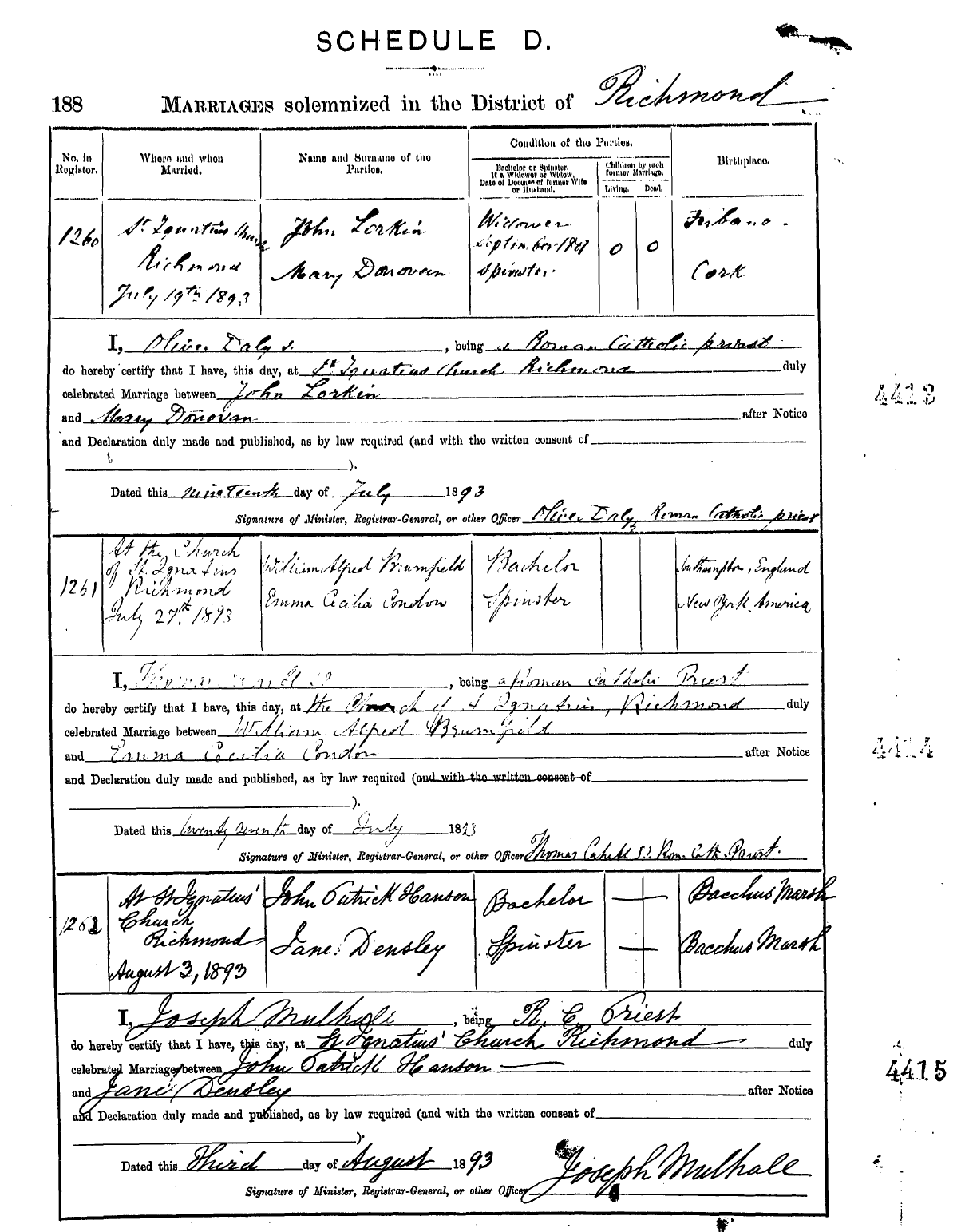
Married 19th July 1893. (nope not a typo). St Ignatius Church Richmond, Victoria. John was recorded as a widower and Mary as a spinster. They told a bit of fib on their certificate and said they didn’t have any children! John gave his place of birth as Ferbane in Ireland and Mary gave hers as Cork in Ireland. They were married in a Catholic church by a Priest. Their witnesses were William Alfred Bromfield from Southampton in England and Emma Cecilia Condon from New York in America.
John records on wedding certificate that he was a widower from September 1889; which begs the question, Was John already married prior to meeting Mary? That would explain why they did not marry till a year before his death.
——————————————————————————————————————–
John joins the diggings – Goldrush!
Somewhere between 1858 and the birth of his first child with Mary Donovan in 1863, John turns up in East Ballarat. What was East Ballarat at the time. Only what is now the oldest part of Ballarat and the place where the Diggers, were panning and mining for gold. The area had one of the highest alluvial goldfields in Australia and was dotted by thousands trying their luck. I expect the fact that John was there, he might have been one of those trying to strike it rich?
Larkin to Lorkin:
This one has stumped many of the family for as long as anyone can remember. What I was told as a child was that there was another family in the Ballan district whose name was Larkin and they kept getting their mail mixed up. Consequently, our John made a decision to change their name to Lorkin.
Ballanee;
Prior to going onto his own property, John and Mary resided at Ballanee, as servants of the large property. I was told that John was hired as a gardener. My grandmother referred to him as having been the head-gardener, but I don’t know in what context that was meant. It was what her mother had told her.
The property of Ballanee at the time the Lorkin’s lived there was owned by C.H.Lyons. Lyons wife, Juliet Lyons kept diaries between January 1862 through to December 1873. Juliet (Anderson)was from a notable Melbourne family and had married Charles Lyons in 1860 and then came to his home at Ballanee.
Our John and family are mentioned in these diaries. John is mentioned in the diaries in relation to the everyday workings of the property. From the research, I have done Ballanee homestead and farm supported a substantial amount of people in its employ.
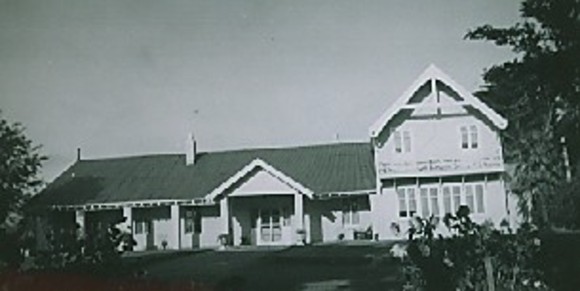
From The Australasian (Melbourne) 5 May 1894; A visit to Ballanee. (several years after John’s death).
Ballanee, the freehold estate now owned by Mr. Lyon, contains about 2,000 acres, and is situated close to the neat village of Ballan the house being about two miles from the railway station. Crossing the branch of the Werribee that runs by the village, the country rises gently to a small pointed hill named after the old settler, Mount Steiglitz.
A good road among pleasant grass-fields leads to the house, which is situated amid an extensive plantation. Like many old Victorian houses, it is a rambling structure with all sorts of surprising rooms tacked on to each other in a most confusing manner. It must be an ideal summer residence for the air (owing to the elevation) is mild in the hottest weather.
All descriptions of European flowers and fruits grow in profusion and are of the highest excellence. Where once the view was shut in by the dense somber forest, one now looks across an open country, with the hills of the volcanic region towards Ballarat for a background.
Those hills, once so densely timbered and with such a tangled mass of undergrowth, are now cleared almost to their summits, while around them are some of the finest farms in Australia.

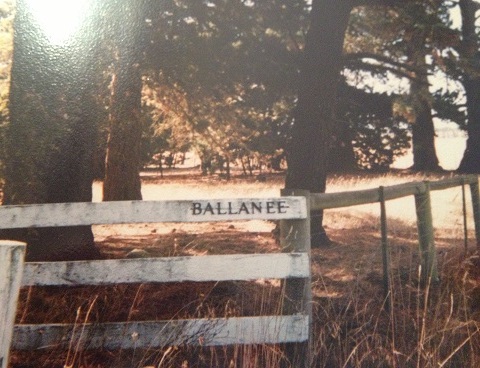
Original held by author.
This photograph on card has been in the family for generations and for many years has been a mystery. I’ve long suspected it was of the gates to Ballanee, but could not verify this. However, I now can thanks to the State Library of Victoria who have digitised a thumbnail of the same gates taken perhaps a few years before from the photographic journal of C.H. Lyons titled “Our Home in the Bush” ( Accession no: H2015.228/1-38 ).
John and the family left Ballanee to go to their new home on the 22nd of November 1869. They had been at Ballanee for eight years in the employ of the Lyons.
Just prior to leaving the Lorkin’s four-month-old son John died at Ballanee on the 31st of October 1869. He was buried in the Old Ballan Cemetery on the Geelong Road. Juliet Lyon wrote in her diary; ” made a large cross of lilies and box and an immorbla of lillies on a cyprus for the grave of John’s child.” Mrs. Lyons continued to call on the Lorkin family after they left Ballanee.
Juliet Lyons, regrettable death at the young age of thirty-five at her father’s house in Melbourne was reported on the 17th March 1874 in The Argus newspaper in Melbourne city. Juliet had had five children with her husband.
LYON. -On the 16th inst., at Fairlie-house, South Yarra, Juliet Vivian, the wife of Charles Hugh Lyon and youngest daughter of Colonel Anderson, C.B., K.H. I can only think she must have been a valued friend to the Lorkin family as it appears her daughter later turns up in the papers as a guest at one of the Lorkin family weddings.
Her husband Charles Lyon would remain on the property until his death in 1905.
——————————————————————————————————————–
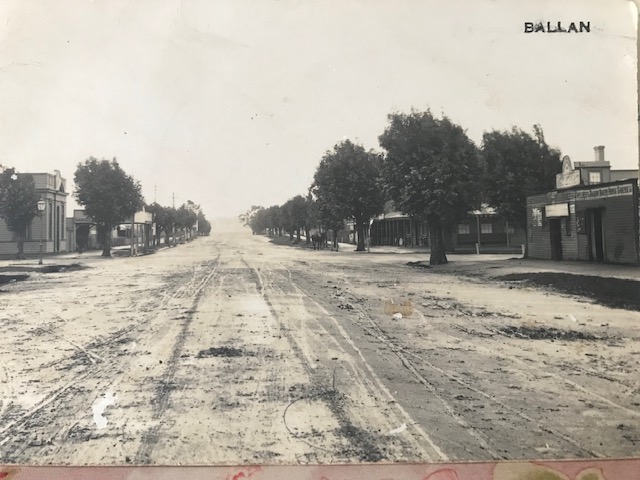
John took up farming on land along what is now the Blakeville Road at Blakeville not far from Ballanee, via Ballan. The property/area was called Colbrook (in some references it is spelled Colebrook), which it remained until after his and his wife’s death when it was sold up. Farming at Colbrook on what is now called Blakeville Road. At the time the area was known as Colbrook and Ingliston not Blakeville Road. The Lorkin family were well represented in these areas as well as Ballan itself. Colbrook and Ingliston were not towns. From what I have been able to find in the newspaper archives it appears John was running sheep on his property as one of his farming endeavors. This was not uncommon in the area. The Lorkin’s were an Irish family of the Catholic faith and their family church was St. Brigid’s in nearby Ballan.
——————————————————————————————————————–
In 1871 John was a gazetted member of the school committee along with some of his neighbours. This would have been a position of some responsibility. At this time it must have borne heavily on John and his fellow committee members that at this time a six-year-old girl had come out at the end of the school day and had died as a result of drowning in a nearby water-hole.
It would appear the area had many such holes for the supply of water to the locals. The coroner had been particularly blistering in his condemnation of those in the area for not fencing off the water-holes; particularly as he had only recently attended the inquiry of another child in the area who had died the same way. He gave the school authorities the instruction that all children were to be thoroughly dissuaded from going near the water-holes alone.
As reported in the Bacchus Marsh Express 4th March 1871; The following gentlemen are gazetted members of school committees: -Gordon, No. 755, Mr. James Edwards, Ballanee, No. 1,081, Messrs. John H. Potter, John Lorkin, James Barr, Robert Scott, and George Blamire
Land acquisitions;
It was reported in the Bacchus Marsh Express on the 27th September 1873 that John Lorkin of the Shire of Bungal had applied to acquire one hundred and fifty acres from the Local Land Board. He was somewhat fortunate in this endeavor as there was a protest from a Maurice Nash who stated he had an earlier claim to three hundred and twenty acres which encompassed the land John had selected. The case was to go to arbitration as Nash had not yet met all of the criteria of occupancy for the land and if his claim could not be substantiated then the land would go to John.
The report in The Argus Newspaper, 17 September 1874;
John’s case for additional land selection makes it to Parliament. The Madden brothers who were members of the Legislative Assembly were also natives born at Cork in Ireland and were staunch Catholics. One can ponder whether these links helped John in his case or in what capacity they came to be assisting John with his claim?
From the Ballan Express 25th January 1873; John (recorded as Larkin), was a founding member of the Ballan Agricultural & Pastoral Society

Where John met with other members of the agricultural and pastoral society.
——————————————————————————————————————–
25 April 1874, Ballan Shire Council Meeting, reported in the Bacchus Marsh Express;
Bacchus Marsh Express 28th September 1878; Mr. John Larkin asked for 2 pounds compensation for damage to the paddock by Thomas Bohan. – The Secretary said that the Engineer had given Bohan an order which made the Council responsible. – The President told the Engineer to be careful to hold back sufficient of Bohan’s money to pay this claim.
——————————————————————————————————————–
Dennis Craffy;
BALLAN. (FROM OUR OWN CORRESPONDENT.) A MAGISTERIAL inquiry was held in the Courthouse, Ballan, on Tuesday last, before E. Blake, Esq., J.P., respecting the death of one, Denis Craffy, who was found lying in a pool of water on the Blakeville road, dead and stiff.
From the evidence given it appears that the deceased left his home, Mr. J. Lorkin’s, near Blakeville, on Sunday morning, stating he was going as far as Ashton’s (about a mile and a quarter distant). He must have proceeded into the town, as he was seen by several persons, and on his way home he called at a house, where he got his tea. He then proceeded on his way, calling at Mr. D. Mc’Rae’s, and” asked him to put him on the straight road.
McRae tried to persuade him to remain the night, as it was then about half-past eight, and pretty dark. However, he refused, stating he would be all right if he once got on the road. They left together, and when parting Craffy said “I shall be all right now; I cannot get drowned.” He then left and was not seen again until the follow ing morning, when he was found as above described by Roderick Steel.
Craffy was a resident of Ballan for over twenty years, having been on the Ballanee estate for the greater portion of that time. He was a native of King’s County, Ireland, 68 years of age, a quiet and inoffensive man, and is supposed to be worth about. 300 or £400, which, in all probability, will go to the Government, as it is not supposed he has made a will.
He was buried on Wednesday afternoon, in the new cemetery. A large number of his friends followed his remains. The cause of death was suffocation caused by falling into a pool of water, and being unable to rise, the heart and other organs being very much diseased.
This is the first I’ve ever heard of Dennis Craffy but I note that he is from the same county as John back in Ireland (Kings).
Death of John Lorkin;
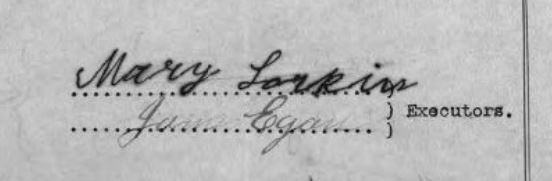
John Lorkin pre-deceased Mary by several years. He died on the 19th of July 1894 at the age of sixty-four. Probate records are available through the Public Records Office Victoria and show that John left his entire estate to Mary. Her signature is recorded on the probate records. John directed that Mary and James Egan would be co-executors.
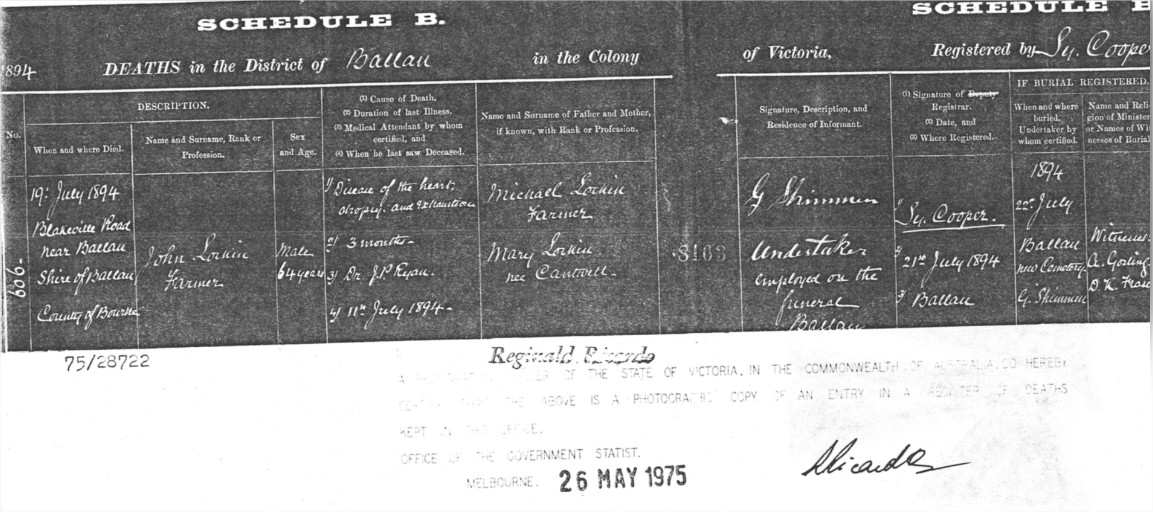
John’s death certificate stated that he died in July 1894 and was born Kilcolgan, King’s County, Ireland. He had been 38 years in Victoria. It also stated he had been married for 32 years to Mary Donovan in Melbourne. Nine children, eight living and one deceased. Aged from 31 to 12 years. The son of Michael Larkin (Farmer) and Mary Cantwell. John died of heart disease .
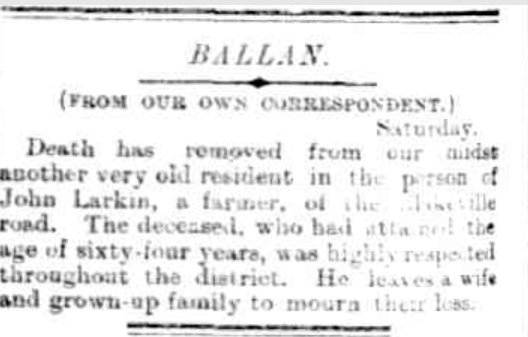
The Bacchus Marsh Express Saturday 28 July 1894 recorded; It is with regret that I have to record the death of another old and respected neighbor, Mr John Lorkin of the Blakeville Road. The deceased has been ailing for some time and passed away on Thursday night last. The funeral took place on Sunday afternoon, and although the weather was wet and cold was largely attended. Mr. Lorkin had attained the age of 64 years and leaves a wife and grown-up family to mourn their loss.
The Argus (Melbourne) Tuesday 24 July 1894, Ballan, Monday;
The funeral of a very old and much-respected resident, Mr. John Lorkin, who died on Thursday took place yesterday, and notwithstanding the cold, wet weather, was attended by a large number of persons. The deceased, who was over 60 years of age leaves several sons and daughters, most of whom are grown up, and a widow in comfortable circumstances.
Table Talk (Melbourne) Saturday 22 September 1894.
John Lorkin of Moorabool East, Farmer by his will dated July 4, 1894, and presented for probate by Messrs. Stawell and Nankivell of Melbourne. Solicitors appointed by his wife Mary and James Egan of Greendale, Farmers, Executors. He bequeathed the whole of his estate to his wife. Testator died July 19, 1894, and the estate is sworn at 650 pounds real and 280 pounds personal; total 930 pounds
Bushfire;
Bacchus Marsh Express 22nd January 1898
Several losses by fire occurred last week on the Blakeville road, when Mrs.Larkin was a sufferer by the destruction of the greater portion of her crop, besides a good area of grass and some fencing. Mfr. W. Fowler lost most of his grass, as well as many chains of fencing. Whilst Perkston’s is demolished, and a goodly portion of Lilbourne’s. A grass fire in this township also caused the destruction of fences and grass.
A magnificent wedding;
The eighteenth of June 1898 was a magnificent day for the Lorkin family at the wedding of John and Mary’s daughter, Mary to Mr. James Maher.
The Australasian reported;
MAHER-LORKIN.
The marriage of Mr. Dennis Maher, second eldest son of Mr. James Maher, New Street. Brighton Beach, with Miss Mary Janie Lorkin, third daughter of the late Mr. John Lorkin, Colbrook, Ballan, took place at the Roman Catholic Church Ballan, on June 8. The Rev. Father O’Hanlon officiating.
The bride, who was given away by her brother, wore a soft white dress, the bodice trimmed with lace and ribbon. Long tulle veil embroidered with silk and fixed with a spray of orange blossom; she was attended by her sister, Miss Katie Lorkin, who was in French grey cloth, with tucked white front and pink bebe ribbon; large white picture hat, trimmed with chiffon and feathers, and wore a gold heart brooch with ruby and pearls (gift of the bridegroom), the best man was Mr. J. Jamieson.
After the ceremony breakfast was served in the dining room of Colbrook. A dance was given in the evening. Following are some of the presents: – Bridegroom to the bride, emerald and ruby ring, bride to bridegroom opal and gold sleeve links. father of bridegroom, cheque, mother of bride, cheque and house linen, Miss Lyon Table linen, Mrs Stawell breakfast set, Mr and Mrs Egan silver breakfast cruet, Mr and Mrs M Lorkin claret jug and glasses, Miss Burnside table cutlery, Mr and Mrs Potter china tea set, Mr W Lay afternoon tea service, Mr and Mrs J Healey cheque, Mr and Mrs H gray (Kew) Sideboard, Mr and Mrs J Conroy, cheque, Mr Crawford lamp with shade, Misses Wakeham, Sawers and Carter, centrepiece for table and bedroom bag, Mr Shaw house linen.
——————————————————————————————————————-
Death of Mary Lorkin;
A week before Mary died her daughter Lily Fowles returned to Blakeville to be with her and the family. She returned to Ferndale after the funeral. Mary died on the 12th March 1915 aged 72. Her obituary from the Ballan Times on the 18th March 1915 read;
One of the early pioneers of this district in the person of Mrs. Lorkin of Colebrook, on Friday last, aged 77 years. Residing in this district since the early sixties, she was widely known and respected. All who came in contact with her were at once attracted by her kindly and generous disposition and great sympathy is expressed with her family in their bereavement. The funeral which took place on Sunday last was largely attended, residents from all parts of the district being present. The interment took place at the Ballan New Cemetery, service at the grave being conducted by the Reverend Father McMahon. The pall-bearers were Messrs; J. Egan, W.J. Andrew, J. Rigney, H. Densley, J. Egan, J.O’Shea and S. Hunt; the coffin bearers being Messrs; Jas. Darcy, J. Bowman, E. Wheelehan, D. McIntosh, J. Egan, L. Higgott and M. Nolan. The mortuary arrangements were carried out by Mr. F.J. Mehrens.
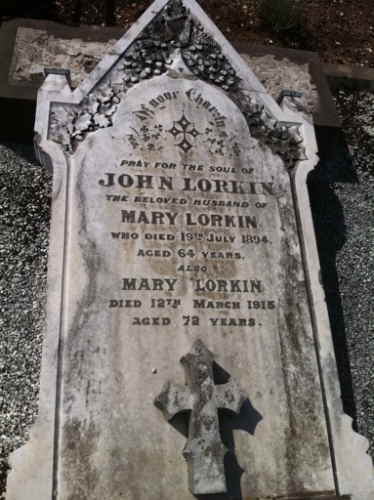
John and Mary are both buried at the New Ballan Cemetery. The inscription on their headstone reads; Pray for the soul of John Lorkin the beloved husband of Mary Lorkin who died 19th July 1894 aged 64 years. Also Mary Lorkin died 12th March 1915 aged 72 years.
Disposal of the Colbrook Property. After Mary’s death, the holdings at Colbrook that made up the Lorkin farm were sold to another local resident and friend of the family CH Platt.
Children of John and Mary Lorkin;
Lily Mary Lorkin was born at Ballarat East in 1864 she married John George Fowles and they moved to Ferndale where they farmed the rest of their lives at their property Everglade. Lily died at Ferndale in 1937. Lily as my ancestor has her own page on this website.

Michael Francis Lorkin born 1865 at Ballanee property in Blakeville, married Hannorah (known as Norah), Agnes Brennan. They lived at Blakeville on their property Blamer’s. After some years they moved their family across to nearby Mid-Hill at Ingliston. It was here that my grandmother used to go and holiday as a child. Michael died in 1943 in Ballarat.
Lucy Ellen Lorkin was born at Ballanee property in Blakeville in 1868. She married Albert Edwin Fowles and they moved to Ferndale also where they carried on farming. Lucy died at Warragul in 1949. They had two children Nellie and Abina.
John Lorkin died as a four-month-old infant at Ballanee on the 31st October 1869.
A further son, also named John Thomas Lorkin was born at Ballanee property in Blakeville in 1872. He married Elizabeth Kennedy on the 18th of September 1906.Mr. John Lorkin, the second son of the late Mr. John Lorkin, of Colhrook, was married to Miss Elizabeth Kennedy second daughter of Mr. James Kennedy,of Ballan, on Wednesday, I8th September. The ceremony was performed by Rev. Rather Cusack, at St. Agnes church, Ballan. The bride, who was given away by her father, was handsomely attired in white silk, trimmed with lace, chiffon, and a spray of orange blossom,. She wore the usual wreath and veil and carried a white prayer book (gift of Miss Brennan). The bridesmaid was Miss Katie Kennedy, sister of the bride, in cream cashmere, with trimmings of lace and medallion, and carried a bouquet of japonica, with red streamers. She also wore a gold brooch,a gift of the bridegroom. Mr .T. J.Kennedy acted as best man. After the ceremony, the party were driven to. The home of the bride’s parents, where the relations add friends sat down: to the wedding breakfast. The usual toasts were honored. The happy couple left on the Adelaide’ express for Ballarat amidst showers of rice and confetti. The bride traveled in a dress of. navy cashmere, Eton coat, and: •with lace and silk, and wore a black Chenile hat. He remained on the farm with his mother until she died in 1915. He had been crippled quite badly as a child in a (cricketing, I vaguely remember being told) accident but still managed to farm successfully. After his mother died he sold the property Colbrook, John Thomas Lorkin had remained with his mother at the home till her death. Later in the year John and Elizabeth moved away from Ballan down to Gippsland where his sisters were living. He and Elizabeth lived the remainder of their lives there, they did not have any children. John died in Warragul in 1950, survived by his wife Elizabeth who wrote a touching tribute to him in The Argus newspaper on the 9th March. LORKIN. – On March 8. at Warragul, John Thomas, beloved husband of the late Elizabeth Lorkin. -Rest in peace.
James Daniel Lorkin born at Colbrook in 1877, married Susan Jane Dwyer in 1898. LORKINN— DWYER— On the 27th April, at St. Josephs. Warragul. by the Rev. Father Coyne, James Lorkin. of Cabanda, Ferndale. Gippsland, third son of the late John Lorkin. Bald Hills, Ballan, to Susie, youngest daughter of Michael Dwyer, J.P., of “Rockingham, Gippsland, late of Collingwood. James was to have significant hardship in his life. He and Susan would move around, no doubt due to his work between Melbourne (his father in laws home) and country locations. In 1905 James and Susan would have a daughter (they already had a son (James). Then on the 2nd November 1906, James was injured in a work accident. Reported in the newspapers ” James Lorkin, a laborer employed in connection with the construction of additions to the Mount Lyell Mining and Railway Company’s superphosphate works at Yarraville, whilst wheeling a barrow along a plank yesterday, overbalanced and with the barrow fell into a concrete pit almost 7ft in depth. It was found that his arm was broken. The injured man is married and resides at Box Hill. Was attended to by Mr. W. H. Donaldson, MR, who then ordered his removal to a hospital. Later that month James wife Susie died, LORKIN.—On the 13th November, at her late residence, Kangerong-road, Box Hill, Susan, the dearly beloved wife of James Lorkin and youngest daughter of M. Dwyer, JP., aged 34 years. R.I.P. If this were not enough tragedy sadly more was to follow when a few days before Christmas James and Susie’s daughter also died. 22 December 1906, Hawthorn, Victoria, Australia LORKIN.— On the 22nd December, at No. 58 Power-street, Hawthorn, Catherine, the dearly beloved daughter of James and the late Susan Lorkin, aged 14 months. R.I.P.
Daniel Patrick Lorkin was born at Colbrook on the 1st January, 1879. At the age of 22 Dan as he was known, moved to Western Australia. It was here in 1904 that he would marry Rachel Josephine Flynn (born Dardanup, WA) in Worsley. Worsley is on the south west of the state and is located near Bunbury. Rachel was a WA local with her parents being Henry Flynn and Ellen Hartnett also both born in WA. Rachel and Dan would have six children, Stella Mary, John Thomas, Irene Ellen, Mabel Catherine and Daniel Patrick Lorkin. Daniel Patrick (Jnr) would serve in the second world war in the Royal Australian Air Force. There is meant to be one more child according to my records (from my late grandmother) but I’m not sure who this is? Dan lived out his life with Rachel in Western Australia and died aged 86 in 1966. Dan would outlive Rachel who died in 1957 aged 73.

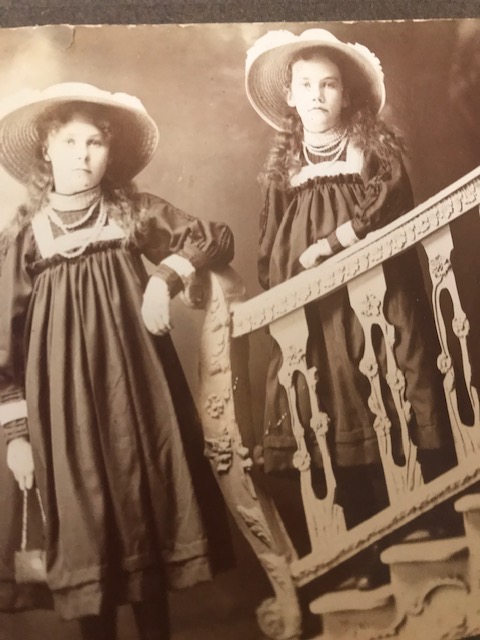
Mary Jane Lorkin was born at Colbrook in 1880. She married Denis James Maher in 1898 and they lived in the Bendigo area.
The Australasian reported; MAHER-LORKIN.
The marriage of Mr. Dennis Maher, second eldest son of Mr. James Maher, New Street. Brighton Beach, with Miss Mary Janie Lorkin, third daughter of the late Mr. John Lorkin, Colbrook, Ballan, took place at the Roman Catholic Church Ballan, on June 8. The Rev. Father O’Hanlon officiating.
The bride, who was given away by her brother, wore a soft white dress, the bodice trimmed with lace and ribbon. Long tulle veil embroidered with silk and fixed with a spray of orange blossom; she was attended by her sister, Miss Katie Lorkin, who was in French grey cloth, with tucked white front and pink bebe ribbon; large white picture hat, trimmed with chiffon and feathers, and wore a gold heart brooch with ruby and pearls (gift of the bridegroom), the best man was Mr. J. Jamieson.
After the ceremony breakfast was served in the dining room of Colbrook. A dance was given in the evening. Following are some of the presents: – Bridegroom to the bride, emerald and ruby ring, bride to bridegroom opal and gold sleeve links. father of bridegroom, cheque, mother of bride, cheque and house linen, Miss Lyon Table linen, Mrs Stawell breakfast set, Mr and Mrs Egan silver breakfast cruet, Mr and Mrs M Lorkin claret jug and glasses, Miss Burnside table cutlery, Mr and Mrs Potter china tea set, Mr W Lay afternoon tea service, Mr and Mrs J Healey cheque, Mr and Mrs H gray (Kew) Sideboard, Mr and Mrs J Conroy, cheque, Mr Crawford lamp with shade, Misses Wakeham, Sawers and Carter, centrepiece for table and bedroom bag, Mr Shaw house linen.
Mary Jane would not stay with James however and as a Catholic was unable to divorce. In 1908 she left James and lived the remainder of her life with Alexander David Fraser of Chiltern. They had two daughters Mary Gertrude (born Echuca) and Bessie (born Chiltern) Fraser. Tragically Mary died on the 12th December 1911 at their home in Grubben (Henty) following a five hour miscarriage causing a haemorrhage that took her and the child’s life. Mary Gertrude and Bessie were only three and two at the time. Alexander had written poignantly in his will that had he been able to he would have married Mary and named her in his will as his ‘wife’. Alexander was brother to Mary’s sister (Kate’s) husband and it was undoubtedly through this connection that they met. Mary was buried at Henty on the 13th December 1911. On the 10th March, 1924 Alexander died. This left his daughters Mary and Bessie only sixteen and fifteen at the time. The probate of his will was completed in the October. His will was dated the 12th of October 1909 had been made when he and Mary had come together. He had been living at Kangaroo Flat when he died and had been recorded as a gardener at Bendigo, formerly residing at Chiltern where he had been a miner. The executors of his will (as Mary had predeceased him) were Sarah Finley Fraser (spinster) and Archibald James Fraser (nurseryman). Both of Panton Street, Bendigo.
Katharine Lorkin. Katharine known as Kate Lorkin was born in Colbrook in 1882. She married widower George Sinclair Fraser in 1905. They moved out to Warragul. She died at Warragul in 1962. “Aunty Kate” as my grandmother referred to her was the aunt who reportedly and somewhat famously said to her sister Lily who was considering whether she should sell part of her farm off after her husbands’ death, “If you can’t have all of the potato why would you want half of it”. Lily kept the whole of the farm.
The following May on the 11th John Lorkin junior married Hannorah Brennan as reported in the Bacchus Marsh Express: Weddings, like Angels whispers, are with us few and far between, still Mr.Michael Lorkin, son of the late Mr. JohnLorkin, of the Blakeville Road, joined hands with Miss Nora Brennan, of Ingliston, to bravo the battles of life. The the nuptial knot was tied by the Rev. FatherO’Hanlan in St. Agnes church in this township on Tuesday last.
Life in early Blakeville as per Michael Francis Lorkin;
When John and Mary’s son Michael Francis Lorkin died in 1943 his obituary in the Ballan Times gave a description of life in the early Blakeville district. 18th March, 1943 – It is with extreme regret that we record the death of Mr. Michael Lorkin, well known and highly esteemed resident of Ingliston, who passed away at Ballarat on Thursday last after a long illness.
The late Mr. Lorkin was 77 years of age, was born at Ballanee and spent his early life at Colbrook, where his parents conducted the farm now owned by Mr. C.H. Plattt. About forty years ago he settled on Mt. Darriwell (better known at Mid-Hill) Ingliston, where he successfully carried on mixed farming until ill health caused his retirement about two years ago, when he came to Ballan to reside with his younger daughter, Mrs. W.H. Wheelehan.
Although well versed in all current topics, Mr. Lorkin took no part in public affairs but lived a quiet industrious life, at peace with the world and no man’s enemy. He was a staunch adherent of St. Brigid’s church. Mr Lorkin was a most interesting conversationalist, with a retentive memory and his stories were real entertainment.
He recalled how as a boy he used to walk from Colbrook to Blackwood through the Wombat State Forest on errands for his parents, as for years he regularly walked from Colbrook to Budins to attend school, (the school building was then situated close to Mr. Frank Mullane’s present residence.)
Few knew the bush as Mr. Lorkin. He was a man of jovial and kindly nature with a most pleasant personality, and throughout his lifelong residence in our midst enjoyed widespread popularity and respect. His demise is universally regretted.
A note on Egan’s and Rigney’s. (updated Sept 2024). The name Egan and Rigney pops up regularly through John and Mary’s life in their official records and importantly it appears the families were closely intertwined. A recent sideways search has turned up that Stephen Rigney and his wife Mary Egan (both from Ferbane) moved to Australia in 1857. They brought their children Thomas, John, Keiran, Maria and Annie with them. (Quite possibly they would have been eligible for the assisted immigration scheme). They would have two more children in Australia Stephen and James. After arriving in Australia they moved to and settled in Ballan. This family will have been close connections of John’s from his home town and could have been relations. I’m going to suggest that the younger Rigney’s were pallbearers at Mary’s funeral. Egan’s were also pall bearers at Mary’s funeral. It is highly likely that Mary Rigney (nee Egan) also had further relations of hers from Ferbane come to Australia and settle in Ballan. There was a John Rigney who was believed to be in Victoria from Ferbane who was being looked for by his sister Bridget Rigney (Ferbane Ireland) in 1881 having mentioned her brother left Ferbane 19 or 20 years ago which is around the same time there appears to have been a fair exodus from Ferbane of the younger people. I’m of the opinion that at least three known families from Ferbane resettled broadly in Ballan and its surrounds during this time period.
 Yews to Eucalypts